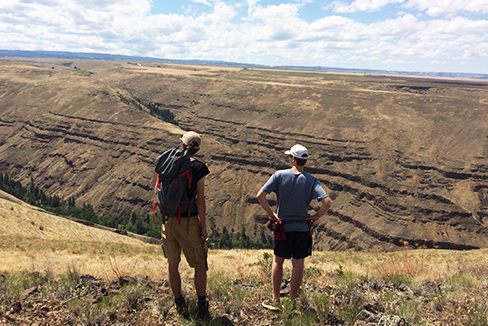




‘How things relate’: Princeton seniors Willow Dalehite, Katherine Irelan explored evolutionary pairings above & below
May 9, 2022 ・ Liana WaitPrinceton senior Katherine Irelan spent two months in summer 2021 walking the slopes of Hawaii Volcanoes National Park searching for specimens of the native shrub pūkiawe (Leptecophylla tameiameiae) for her senior-thesis research on how the plant allies with soil fungi…
World’s thinnest roots are ‘underground weapons’ in ecological competition
February 14, 2022 ・ Liz Fuller-WrightMost of us only think about the easily visible parts of plants — stems, flowers, leaves — but in a new study published in the Proceedings of the National Academy of Sciences, Princeton ecologists Lars Hedin and Mingzhen Lu show that the hidden root…
PEI awards $1.01 million in Water and the Environment Grand Challenge projects
October 1, 2019 ・ Morgan KellyThe ecological impacts of extreme weather, a national “climate park” in the New Jersey Meadowlands, and engineered nanoparticles that target groundwater pollutants are among the 13 projects funded by the Princeton Environmental Institute (PEI) as part of its Water and…
Plants and microbes shape global biomes through local underground alliances
April 17, 2019 ・ Morgan KellyDense rainforests, maple-blanketed mountains and sweeping coniferous forests demonstrate the growth and proliferation of trees adapted to specific conditions. The regional dominance of tree species we see on the surface, however, might actually have been determined underground long ago. Princeton…

Theory suggests root efficiency, independence drove global spread of flora
February 21, 2018 ・ Morgan KellyResearchers from Princeton and the Chinese Academy of Sciences suggest that plants spread worldwide thanks to root adaptations that allowed them to become more efficient and independent.

Princeton, Stockholm University team up to explore ‘Earth in 2050’ global environment
December 7, 2017Researchers from Princeton University and the Stockholm Resilience Centre met for “Earth in 2050: Boundaries, Obstacles and Opportunities” Nov. 12-14 to discuss key issues related to the global environment.
Understanding How Tropical Forests Recover After Human Disturbance
May 26, 2016 ・ Joanna M. Foster '08 for the Princeton Environmental InstituteWhen Connor Stonesifer ’16 first arrived in Panama in the summer of 2015, his Spanish consisted of saying “I want” and having to point at things. When he asked the woman who ran the hostel where he was staying to…
Theory of ‘Smart’ Plants May Explain the Evolution of Global Ecosystems
December 1, 2015 ・ Morgan Kelly, Office of CommunicationsIt’s easy to think of plants as passive features of their environments, doing as the land prescribes, serving as a backdrop to the bustling animal kingdom.
Colvin Recipient Studies Nutrient Uptake in the Flood Plains of the Mississippi River
May 22, 2015 ・ Nick DiUlio for the Princeton Environmental InstituteSunset over the Mississippi River. (Photo credit: Katherine Smith) For many years Katherine Smith has been fascinated by the complexities of riparian ecology, but as she approached her senior year at Princeton University the ecology and evolutionary biology major felt…
