



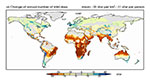
Climate Change to Alter Global Pattern of Mild Weather
January 19, 2017 ・ Morgan Kelly Office of CommunicationsScientists from Princeton University and the National Oceanic and Atmospheric Administration (NOAA) have produced the first global analysis of how climate change may affect the frequency and location of mild-weather days.
Giant Middle East Dust Storm Caused by a Changing Climate, Not Human Conflict
January 13, 2017 ・ Matt Soniak for the Office of Engineering CommunicationsResearchers have determined that the massive late-summer 2015 dust storm in the Middle East was caused by a changing climate and was not attributable to the civil war in Syria, as many media outlets reported.
Tree-Bark Thickness Indicates Fire-Resistance in a Hotter Future
January 11, 2017 ・ Catherine Zandonella, Office of the Dean for ResearchA Princeton University-led study has found that trees in fire-prone areas around the world develop thicker bark. The findings suggest that bark thickness could help predict which forests and savannas will survive a warmer climate in which wildfires are expected to increase in frequency.
A New Professional Ethics for Sustainable Prosperity
January 6, 2017 ・ Igor HeifetzBeing a responsible professional, entrusted by society with the privileges of such a role, should involve an orientation to taking initiative in bringing about the future that global society most needs.

The Fire Through the Smoke: Working for Transparency in Climate Projections
January 4, 2017 ・ Morgan Kelly, Office of CommunicationsTo help policymakers more confidently prepare for the effects of climate change, a group of climate scientists evaluated the scientific work behind the most recent projections from the IPCC regarding the potential ecological, social, economic and meteorological repercussions of climate change.

Climate Policy Simulator Forces Users to Confront Ethics and Science Behind Policy Choices
December 19, 2016 ・ B. Rose Kelly, Woodrow Wilson SchoolTo explain the interconnectivity of science and value judgments, Princeton University’s Climate Futures Initiative (CFI) has launched a climate policy simulator.
PEI Faculty Seminar Series Video: The Suffering of Wild Animals: Should we do anything about it, and if so, what?
November 15, 2016 ・ Igor HeifetzPeter Singer, Ira W. Decamp Professor of Bioethics in the University Center for Human Values Most of us accept that suffering is an intrinsically bad thing, even if it may sometimes lead to good consequences. That judgment is, I suspect,…
PEI Faculty Seminar Series Video: Competition, Hydraulic Damage, and the Universal Rules Regulating Plant Water Use
October 11, 2016 ・ Igor HeifetzTiny valves on the surfaces of leaves, called stomates, regulate carbon gain and water loss by plants, and are thus linchpins of the global carbon and water cycles. Amazingly, the same simple model regulates stomates worldwide. This model is backed…
PEI Faculty Seminar Series Video: Probabilistic Coastal Hazards Mapping for the US
November 15, 2016 ・ Igor HeifetzImproving coastal resiliency, and the adoption of natural infrastructure as part of a multiple lines of defense strategy, relies on effective coastal flood hazards and risk assessment and risk management. Current flood hazards maps do not adequately consider geomorphological, physical…

