



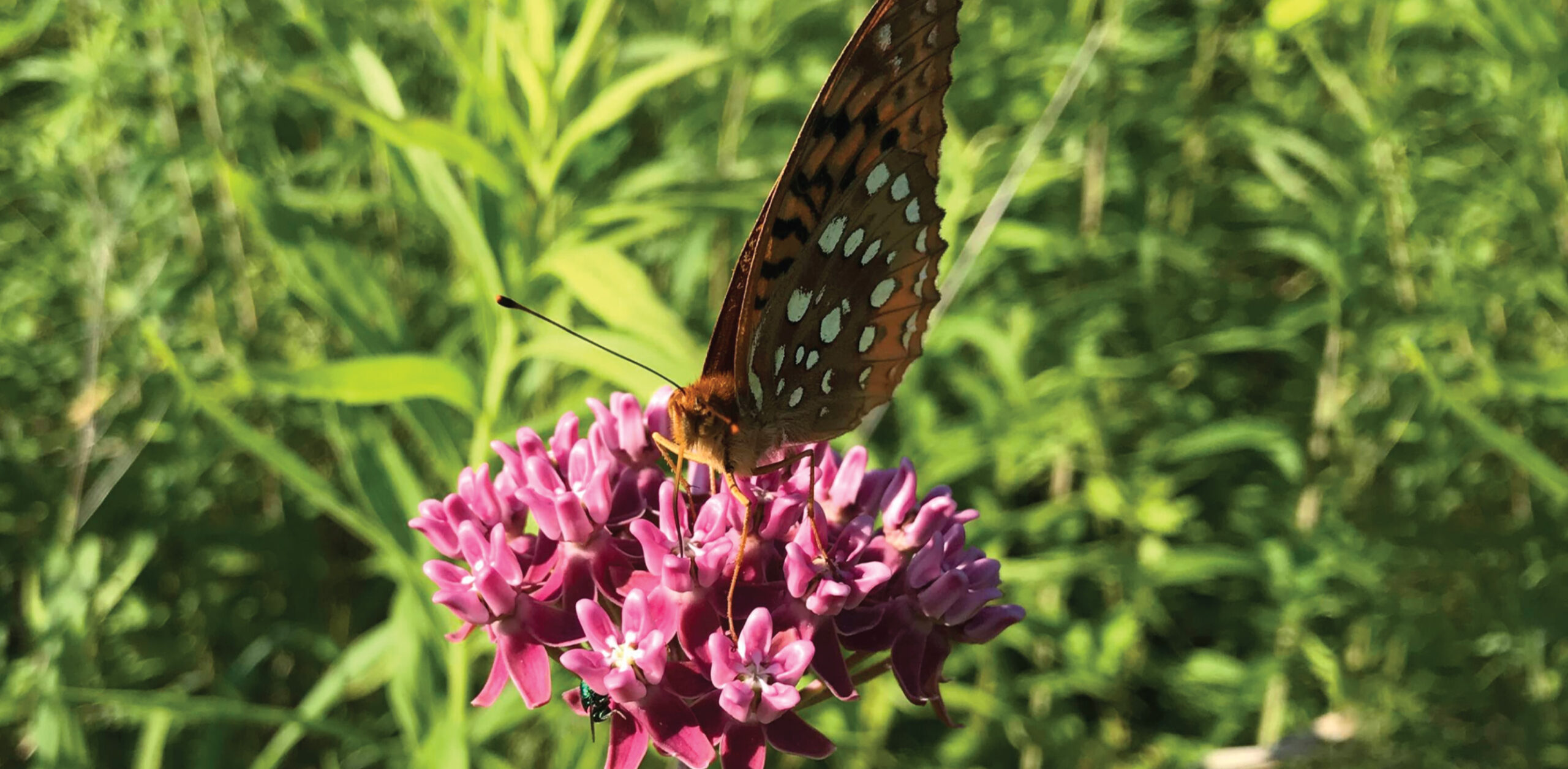

(Photo by Morgan Kelly)
How the decline in pollinators ripples across entire ecosystems
The ongoing loss of pollinators such as honeybees and butterflies could stack the deck in favor of plants that are better at competing for pollinators — with a significant cost to plant biodiversity, Princeton University-led researchers reported in the journal Nature. This could in turn negatively affect the organisms that depend on whatever plants are lost and pose a significant threat to ecosystem health.
“This finding is alarming because it suggests that more than simply removing a mutualist, ongoing pollinator decline may unravel the very fabric that keeps plant diversity stable,” said senior author Jonathan Levine, a Princeton professor and chair of ecology and evolutionary biology and associated faculty in the High Meadows Environmental Institute (HMEI). “Our study identifies an unexpected and insidious way in which the loss of some species in an ecological network can trigger the loss of still others.”
Ecologists know that many flowering plants compete to attract pollinators — which are essential for reproduction — in the same way that they compete for resources such as sunlight, water and soil nutrients. In a world where pollinators are declining, we would expect competition for pollinators to increase, but the implications of increased competition have been unclear.
If plants of the same species can monopolize pollinators when they are together — for example, by putting on showy floral displays as a group — then this would disadvantage rarer plant species and undermine their coexistence in the long-term.
(Photo by Mirjam von Rütte)
First author Christopher Johnson, now a research scientist at the University of Basel, spearheaded the project as a Princeton postdoctoral researcher in Levine’s research group. He, Levine and coauthor Proneet Dutt of ETH Zürich combined tightly controlled field experiments with mathematical models.
“This study builds on years of work in our group designing field experiments to inform mathematical models that predict the coexistence or exclusion of species,” Levine said. “Here, these methods pay off in revealing the hidden impact of plant competition for pollinators on plant diversity.”
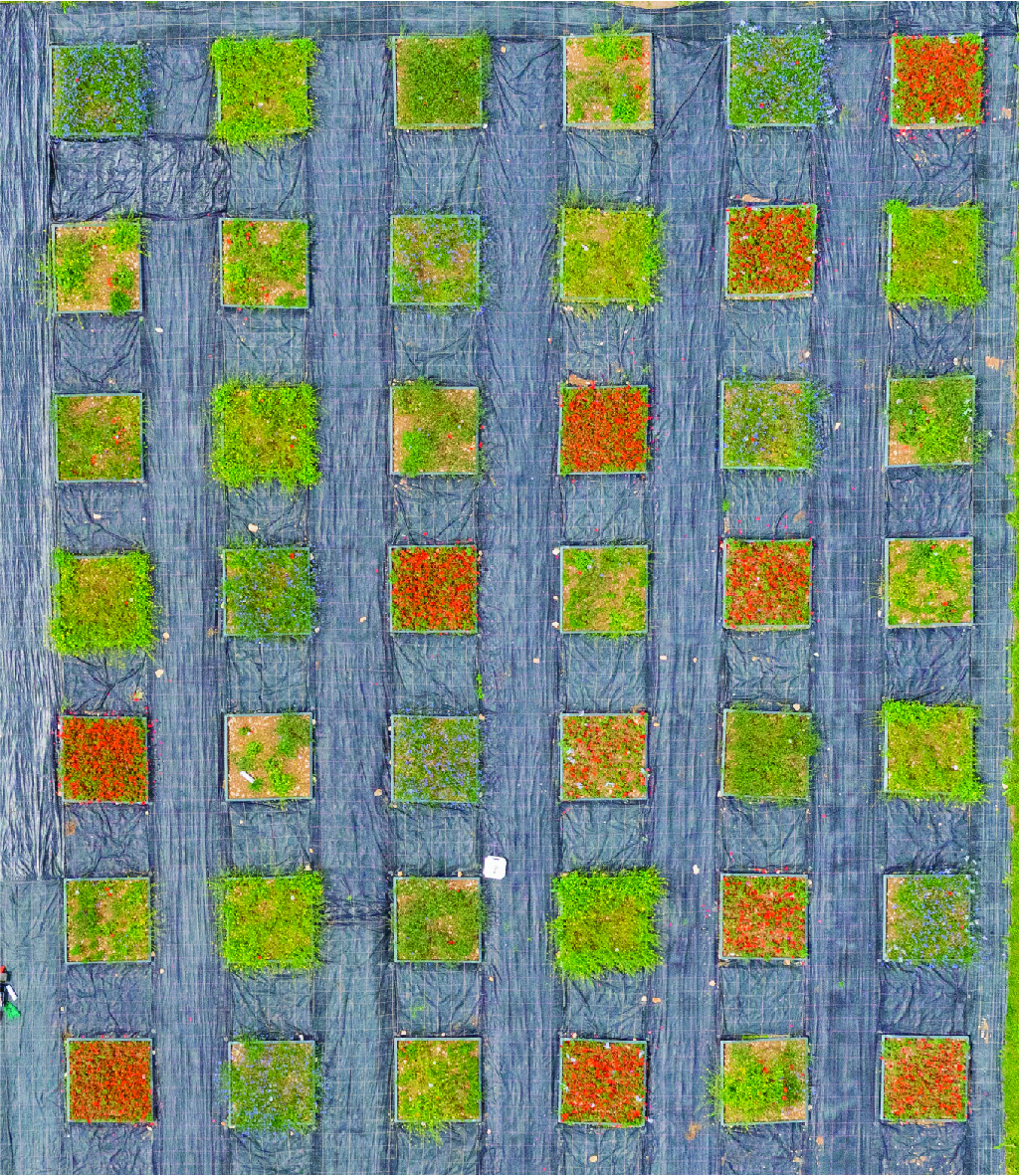
The team constructed an experimental plant community consisting of five annual species spread across 80 plots within an area around the size of two and a half tennis courts. Each plot focused on the effect one competitor species had on each of the other four species. To experimentally remove competition for pollinators, the researchers used paintbrushes to manually pollinate some plants. Other plants were left to the whims of the local pollinator community, which consisted mostly of honeybees and bumblebees, plus some solitary bees and syrphid flies.
“Insect pollinators are much better pollinators than us, but they wouldn’t necessarily visit every plant,” Johnson said. “We were extremely faithful pollinators — we would pollinate every single flower, not just those that were abundant and showy, but also flowers that were buried by their competitors.”
At the end of the summer, the study team collected all the seeds produced by each plant, took them back to the lab, and “counted and sprouted them” to determine the number of viable seeds that actually produced a seedling.
Their results suggested that an overall decline in pollinators could affect some plant species more severely than others.
“Perhaps unsurprisingly, shrinking the pollinator diversity down to a single species at very low densities led to drastic drops in both pollinator visits to flowers as well as per-plant seed production,” Johnson said.
“It’s a bit of a cautionary tale that pollinator decline may have severe consequences for plants,” he said. “As someone who’s been out in the field and pretended to be a pollinator and tried to pollinate those plants, I can say that the ecosystem service that they provide is tremendous. Insect pollinators can’t be easily replaced, and we really should be focused on conserving pollinator diversity.”
“Competition for pollinators destabilizes plant coexistence,” by Christopher A. Johnson, Proneet Dutt and Jonathan M. Levine, published July 20 in Nature (DOI: 10.1038/s41586-022-04973-x) was supported by Princeton University, the ETH Zürich Center for Adaptation to Changing Environments, and the National Science Foundation (DEB 2022213).