



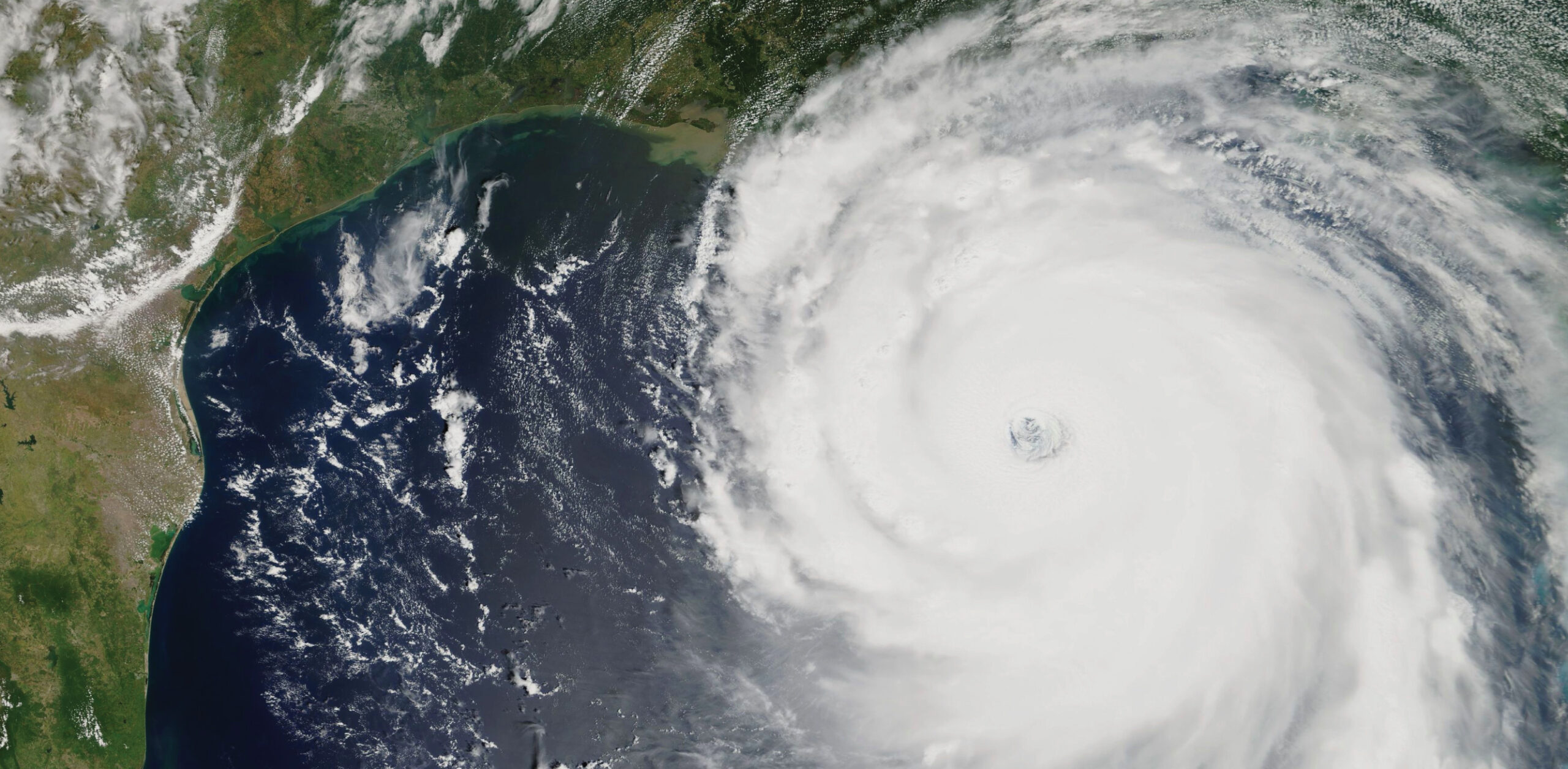

How Do Tropical Cyclones Influence Global Climate?
Our changing climate fuels stronger hurricanes. But hurricanes themselves also change the climate. A new study examines how.
To better forecast the effects of hurricanes on the climate — such as on ocean temperatures and cloud cover—a team of Princeton University researchers have developed a tool for modeling their global climate consequences. Their results are published in a new paper in the Journal of Geophysical Research: Atmospheres.
“We can think about hurricanes like stones and the climate system like a pond: these storms have ripple effects that can impact the global climate,” said lead author Gabriel Rios, a Ph.D. candidate in Geosciences and the Atmospheric and Oceanic Sciences program at Princeton. “By simulating an artificial world with less hurricane activity, we can compare that to our own world to understand how tropical cyclones change our climate system.”
Intense evaporation over tropical oceans leads to devastating hurricanes, as shown by the recent impacts of Hurricanes Helene and Milton. These storms move large amounts of water and air over long distances, altering global patterns of both cloud cover and precipitation.
To understand such large-scale impacts, the team developed an algorithm to simulate suppressed wind-induced surface heat exchange (“SWISHE”) that models reduced hurricane activity by capping evaporation where hurricanes commonly form, such as in the Caribbean and off the coasts of China and the Philippines. They applied SWISHE to three climate models from the National Oceanic and Atmospheric Administration (NOAA) and studied its impact on hurricane activity over the course of 50 years.
Results showed that this hypothetical evaporation suppression reduced overall tropical cyclone frequency by 44% and reduced the frequency of intense “hurricane-strength” cyclones by 90% – all but eliminating them. Contrasting these artificially hurricane-reduced simulations against real-world conditions reveals ways in which hurricanes themselves change the climate.
Looking ahead, the team plans to use SWISHE to investigate how hurricanes impact other aspects of global climate. “Our results show that this algorithm can serve as a starting point for understanding the effects of hurricanes on the climate system,” said Rios. “Our long-term goal is to use this as a tool to help further increase accuracy in projections of future hurricane activity.”