



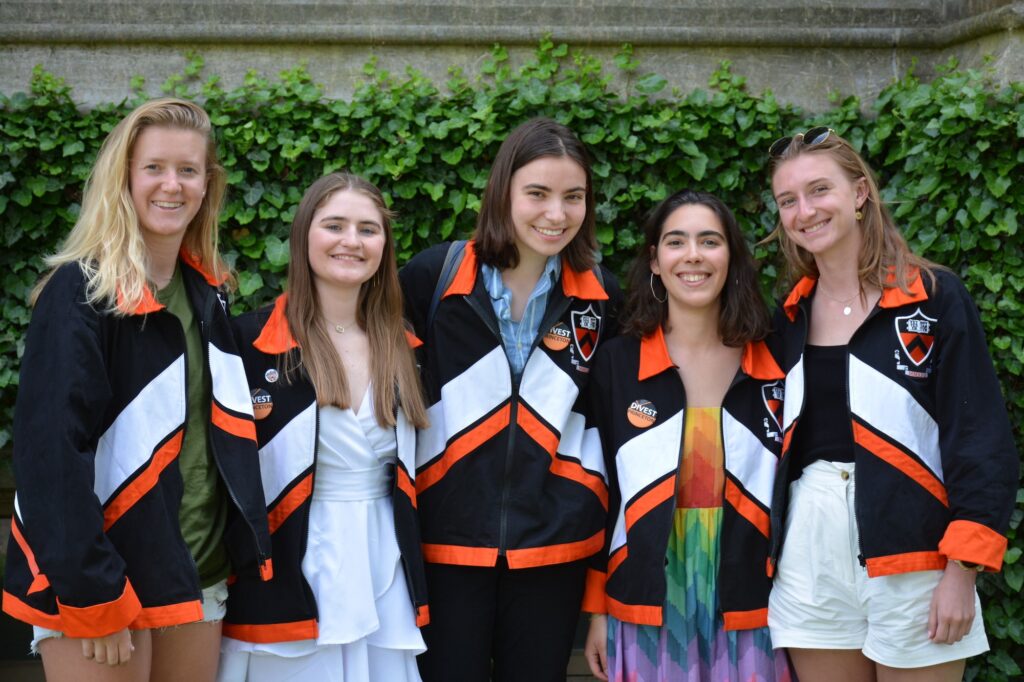
Pictured are (from left): Grace Barbara, Ruth Schultz, Erik Peters, Jessica Lambert, Hannah Reynolds, Katryna Niva, Keely Toledo, Tatijana Stewart, Adelina Rolea, Kajsa Souter, Katherine Ross, Maria Fleury, Richard Ma, Bryan To, and Pooja Parmar.
(Photos by Morgan Kelly, High Meadows Environmental Institute)
ENV Class Day 2022 celebrates seniors for rigor and breadth of research, commitment to the environment
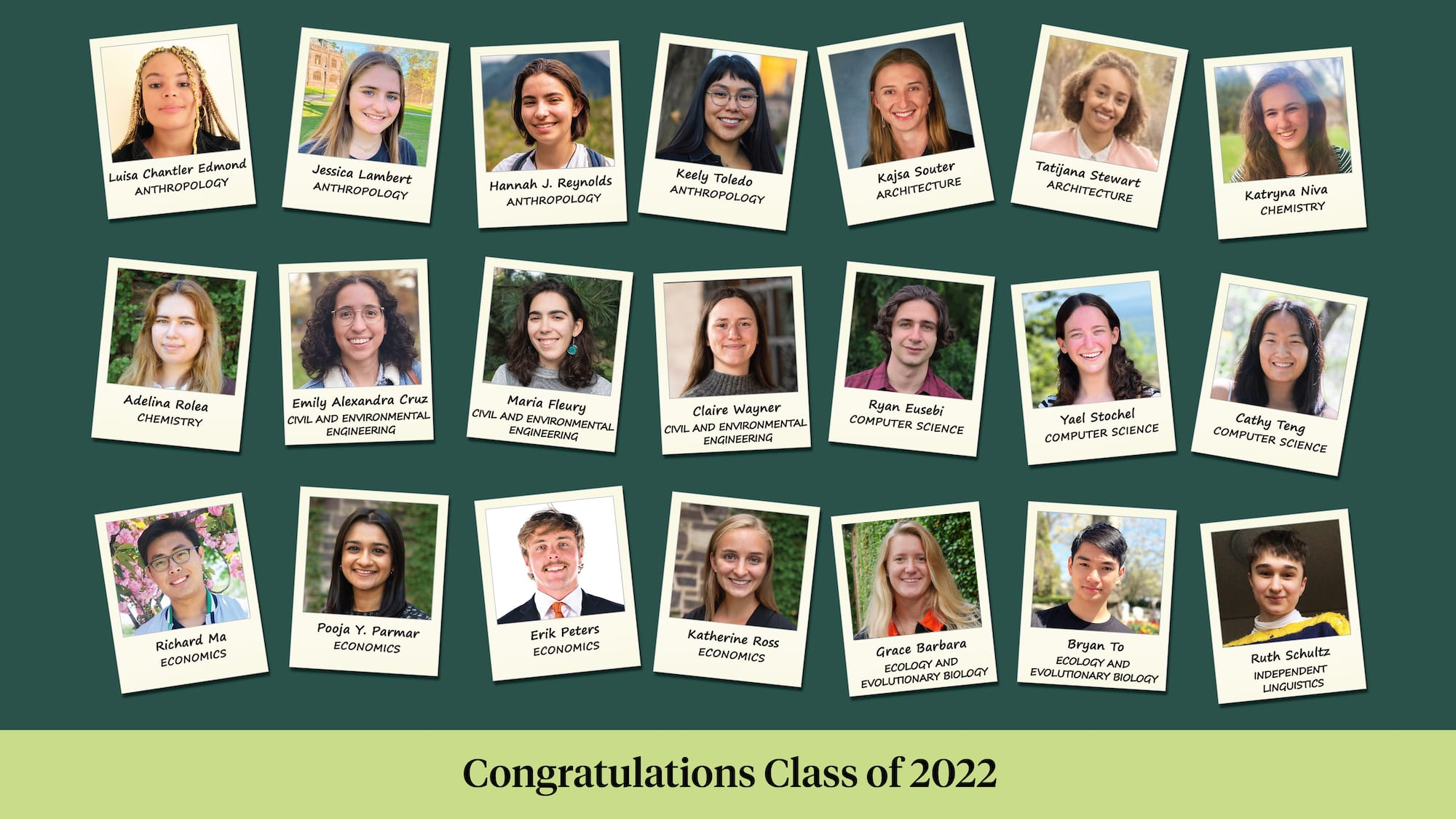
Students and parents joined faculty, researchers and staff from the High Meadows Environmental Institute (HMEI) and the Program in Environmental Studies for the first in-person Class Day ceremony since 2019 to celebrate the 21 Princeton University seniors who are the latest recipients of certificates in environmental studies (ENV).
Held May 23, ENV Class Day 2022 recognized students for their exceptional work throughout their four years at Princeton and especially for the quality and interdisciplinary breadth of their senior thesis research.
“The scholars whose accomplishments we celebrate today built rigorous disciplinary understanding — and forged interdisciplinary connections — to uncover the character of, and define solutions to, a wide variety of environmental questions,” said HMEI Director Gabriel Vecchi, professor of geosciences and the High Meadows Environmental Institute.
“I am confident that as they leave Princeton, our class of 2022 is prepared to bring deep understanding of complex interactive systems and a passion for the environment and scholarship to help our world address our present and future environmental challenges,” Vecchi said. “With that, how can we be anything but optimistic?”
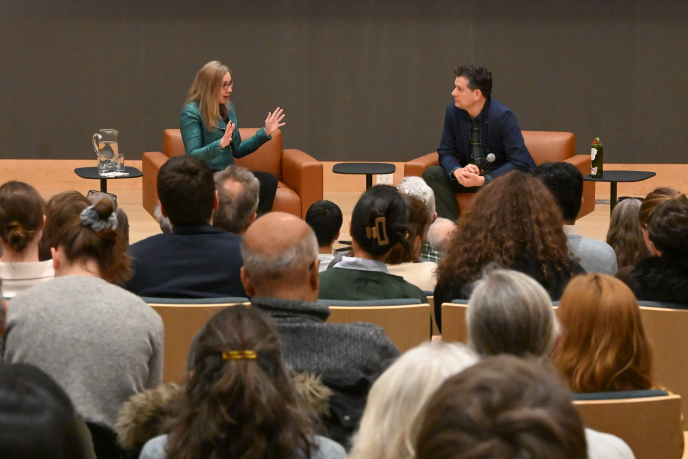
ENV Program Director Corina Tarnita, professor of ecology and evolutionary biology, encouraged graduating seniors to seize the opportunities they will encounter to apply their various talents, experiences and careers to protecting and preserving the planet as it is increasingly shaped by climate change and environmental crises.
“A staple of Class Day is to say go on and do great things, and I have no doubt that you all will,” Tarnita said. “I will add to that one other thing that I hope will become a staple for the ENV program and that is to remain vigilant for opportunities to make environmental change. And there isn’t just one way to do that. Within the constraints of your time, energy, interests and talents, remain committed to applying the things you have learned at Princeton to your unique contribution to making the world a better place.”
Before the names of certificate recipients were read, the seniors who received prizes from HMEI for outstanding thesis research, or for their exceptional engagement with environmental studies, were recognized.
Jessica Lambert in anthropology received the Peter W. Stroh ’51 Environmental Senior Thesis Prize for her work measuring and documenting residents’ lived experiences with environmental contamination in McAlester, Oklahoma, on the reservation of the Choctaw Nation — of which Lambert is a member — where the United States military decommissions bombs via detonation. Lambert also identified regulatory hurdles that prevent the public from understanding existing health and environmental data for McAlester, and created visualizations to make those figures palatable for a lay audience. [Watch a video presentation of Lambert’s thesis research]
“Jessica’s thesis is an eye-opening oeuvre and a creative challenge to the practice of social science and environmental studies in the 21st century,” said Ryo Morimoto, Lambert’s adviser and an assistant professor of anthropology, who highlighted Lambert’s dedication to promoting Native and Indigenous rights at the University as co-president of Natives at Princeton and co-founder of the Princeton Indigenous Advocacy Coalition.
“It is a rare and rewarding experience to encounter a senior thesis with the potential to shake the ground of one’s discipline and to pose broader questions of the meaning and ethics of conducting research,” he said.

Grace Barbara in ecology and evolutionary biology received the Environmental Studies Senior Thesis Prize for her work tracking the migration of marine species from a natural to an artificial coral reef off the coast of Delray Beach, Florida, which found that biodiversity at the artificial reef increased steadily to more than half of what existed at the natural reef. [Watch a video presentation of Barbara’s thesis research]
Stephen Pacala, the Frederick D. Petrie Professor in Ecology and Evolutionary Biology and Barbara’s adviser, described how Barbara’s fieldwork “documented painstakingly the reassembly of the ecological community over the course of the year” and was a “spectacular demonstration” of the Theory of Island Biogeograhphy developed at Princeton.
“Coral reefs represent the ecology canary in the global warming coal mine right now,” Pacala said. “This work showed that this design in this kind of location provides one of the bright lights for us to move forward. It’s a publishable piece of work and it represents an extraordinary amount of effort.”

Three Environmental Studies Book Prizes were presented to students who conducted exceptional research and demonstrated an ability to communicate about it.
Emily Cruz in civil and environmental engineering received the prize in Engineering and Applied Science for evaluating how financial institutions’ policies related to sustainability and fossil fuel industries may affect their future carbon emissions and contribute to policy goals of achieving net-zero emissions by 2050. [Watch a video presentation of Cruz’ thesis research]
In remarks read by Tarnita, Cruz’ primary adviser, Chris Greig, the Theodora D. ’78 & William H. Walton III ’74 Senior Research Scientist in the Andlinger Center for Energy and the Environment, said that “the results reveal a critical disconnect between public narrative on climate change from America’s largest banks and their actual investing and lending policies.”

Kajsa Souter in architecture received the book prize for Humanities for outlining design and policy pathways to increasing walkability and decreasing automobile dependence for Australian suburbs. Tarnita read comments from Souter’s adviser, Mario Gandelsonas, the Class of 1913 Lecturer in Architecture and professor in the School of Architecture, who said that her work “makes an important contribution to the understanding of urban and environmental issues based on original archival and field research.” [Watch a video presentation of Souter’s thesis research]
Katherine Ross in economics was honored with the book prize in Social Sciences for her finding that speakers of languages that do not distinguish between persons in their verb conjugation tend to be more tolerant and concerned for the environment. Tarnita read comments from Ross’ adviser, Alessandro Lizzeri, professor of economics, in which he noted Ross’ creation of a database of verb conjugation in various languages: “This was a thoughtful, ambitious and very creative thesis that is a superb example of interdisciplinary at the boundary between linguistics, economics and environmental studies.” [Watch a video presentation of Ross’ thesis research]

The second annual Henry Horn Prize was presented by Elizabeth Horn, widow of the late Henry Horn, professor of ecology and evolutionary biology, emeritus, and founding director of the Program in Environmental Studies. The prize recognizes the graduating senior in the Certificate Program in Environmental Studies who has produced the best video presentation of their independent research for a broad audience.
Maria Fleury in civil and environmental engineering received the prize for her video presentation of her thesis, “Hanging Water Availability in the São Francisco River Basin, Brazil: Exploring the Role of Expanding Agriculture and Climate Change.” Honorable mentions went to Grace Barbara in ecology and evolutionary biology and Kathy Teng in computer science.
Hannah Reynolds in anthropology received the T. A. Barron Environmental Leadership Prize for her academic excellence, engagement in campus environmental activities, and her ethnographic senior thesis field research on how Alaska’s Tongass National Forest — the world’s only unfragmented temperate rainforest — is constituted and valued by the different groups of people who depend upon the forest culturally and economically. Her work was supported by the HMEI Environmental Scholars Progam and sought to provide a new policy path for managing the forest that emphaiszes the needs of local and Native peoples, as well as protects one of Earth’s largest carbon sinks. [Watch a video presentation of Reynolds’ thesis research]
At Princeton, Reynolds has been active in environmental advocacy and peer mentoring. As a member and co-coordinator of Divest Princeton, she organized the fossil fuel divestment campaign on campus and among alumni. She also worked in the Office of Sustainability where she established a database of Princeton alumni that was adopted to help students connect with Princeton alumni working in environmental careers. As a 2019 HMEI environmental summer intern, Reynolds worked as a teaching assistant for the North Kenya Conservation Clubs based at the Mpala Research Centre.
In addition, she served as a peer academic adviser in Princeton’s Rockefeller College, a refugee resettlement research assistant in the Office of Religious Life, and an English-language conversation partner in the McGraw Center for Teaching and Learning. As a columnist for The Daily Princetonian, Reynolds wrote on issues concerning the environment and environmental justice, including land rights in Tongass and fossil fuel divestment.
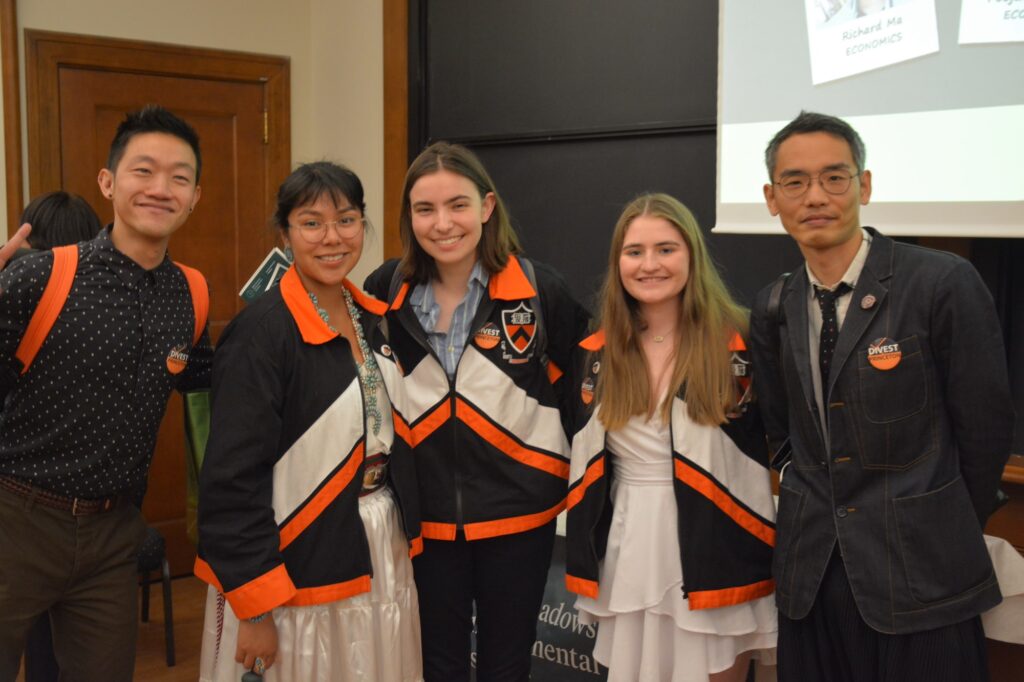
Jerry Zee, Reynolds’ co-adviser, assistant professor of anthropology and the High Meadows Environmental Institute, said that the Barron prize is a “well-deserved recognition of the tireless work that Hannah has done in thinking and pushing for action on environmental issues that impact existentially the prospect of continued habitation on this planet.”
“Hannah’s work takes place both on campus, where she’s worked to push the University to live up to its own lofty ideals of service, and off-campus with the extensive collaborative activist and research network she’s developed,” Zee said. He said that Reynolds’ thesis on the Tongass’ existence at the intersection of different designs on nature and the political complexities of land use is a “stunning piece of scholarship in its own right, but it also illustrates how Hannah thinks about the environmental crisis and its politics as a question that goes beyond the politics of this moment.”
HMEI Class Day Awards and Prizes
Peter W. Stroh ’51 Environmental Thesis Prize
The Peter W. Stroh ’51 Environmental Senior Thesis Prize was established in 2003 as a memorial to Peter W. Stroh ’51, an active member of HMEI’s Advisory Council and an enthusiastic supporter of the Environmental Studies Program. The $2,000 prize is awarded annually to the student who has produced the best thesis on an environmental topic.
 Jessica Lambert, Anthropology
Thesis title: “Defending Our Freedom: The U.S. Military, Environmental Contamination and Ongoing Native Land Theft in the Choctaw Nation”
Thesis adviser: Ryo Morimoto, Assistant Professor of Anthropology
Environmental Studies Senior Thesis Prize
The Environmental Studies Senior Thesis Prize is awarded annually to one senior in the Environmental Studies Certificate Program who has produced the best thesis in the broad area of environmental studies. Student nominations are made by departmental thesis advisers.
 Grace Barbara, Ecology and Evolutionary Biology
Thesis title: “From Bare to Brilliant: The Migration of Fish Species to a Newly Deployed Artificial Coral Reef in Delray Beach, Florida”
Thesis adviser: Stephen Pacala, Frederick D. Petrie Professor in Ecology and Evolutionary Biology
Environmental Studies Book Prizes
The Environmental Studies Book Prizes recognize students for the best poster or presentation of outstanding senior-thesis research, and their ability to communicate the results and significance of their work. Candidates are interviewed by HMEI faculty and members of the institute’s executive committee, who then select the winners.
Engineering and Applied Science
 Emily Cruz, Civil and Environmental Engineering
Thesis title: “Modeling the Carbon Emissions of Financing Policies of Major Financial Institutions”
Thesis advisers: Chris Greig, Theodora D. ’78 and William H. Walton III ’74 Senior Research Scientist, Andlinger Center for Energy and the Environment; Ian Bourg, Assistant Professor of Civil and Environmental Engineering and the High Meadows Environmental Institute
Humanities
 Kajsa Souter, Architecture
Thesis title: “From Modernity to Walkability: The Role of Suburban Walkability in the Decarbonisation of Australian Cities”
Thesis advisers: Mario Gandelsonas, Class of 1913 Lecturer in Architecture and Professor of School of Architecture
Social Sciences
 Katherine Ross, Economics
Thesis title: “You vs. Me: The Effect of Primary Language Verb Conjugation on Tolerance Attitudes and Altruistic Behaviors”
Thesis adviser: Alessandro Lizzeri, Professor of Economics
T. A. Barron Environmental Leadership Prize
The T. A. Barron Environmental Leadership Prize recognizes a member of the graduating class who has distinguished himself or herself by showing exceptional dedication to environmental concerns, not only in formal classes and independent academic work, but also by leading and encouraging activities among fellow students and in the community at large.
 Hannah Reynolds, Anthropology
Thesis title: “What Is the Forest? Land, Culture and the Politics of Resilience in the Tongass of Southeast Alaska”
Thesis adviser: Jerry Zee, Assistant Professor of Anthropology and the High Meadows Environmental Institute
Henry Horn Prize
Established in 2021, the Henry Horn Prize recognizes the graduating senior in the Certificate Program in Environmental Studies who has produced the best video presentation of their independent research for a broad audience. The prize honors the late Henry Horn, professor of ecology and evolutionary biology, emeritus, and founding director of the Program in Environmental Studies.
First Place
 Maria Fleury, Civil and Environmental Engineering
Thesis title: “Hanging Water Availability in the São Francisco River Basin, Brazil: Exploring the Role of Expanding Agriculture and Climate Change”
Thesis adviser: Michael Oppenheimer, Albert G. Milbank Professor of Geosciences and International Affairs and the High Meadows Environmental Institute
Honorable Mentions
Grace Barbara, Ecology and Evolutionary Biology
Thesis title: “From Bare to Brilliant: The Migration of Fish Species to a Newly Deployed Artificial Coral Reef in Delray Beach, Florida”
Thesis adviser: Stephen Pacala, Frederick D. Petrie Professor in Ecology and Evolutionary Biology
 Cathy Teng, Computer Science
Thesis title: “Deploying Deep Learning to Estimate the Abundance of Marine Debris from Video Footage”
Thesis advisers: Constantinos Hadjistassou, Associate Professor of Engineering, University of Nicosia (Cyprus)
Becky Colvin Memorial Award
Darcy Chang ’23 and Joanna Shoubaki ’23, both in ecology and evolutionary biology, received 2022 Becky Colvin Memorial Awards, which are presented by HMEI and the Department of Ecology and Evolutionary Biology to provide support for travel, research supplies, and other expenses associated with field research for the senior thesis.
 Chang, who is advised by Mary Caswell Stoddard, associate professor of ecology and evolutionary biology, will contribute to the Stoddard Lab’s ongoing research in the Rocky Mountains into how broad-tailed hummingbird behavior is changing as a result of climate change by examining how males are responding to differences in snowmelt and the timing of spring flower blooms occurring as global temperatures rise.
 Shoubaki, advised by Sarah Kocher, associate professor of ecology and evolutionary biology and the Lewis-Sigler Institute for Integrative Genomics, will explore the role of chemical signaling in communication, and in the establishment and maintenance of social behavior, in the bee species Lasioglossum baleicum as part of the Kocher Lab’s larger work addressing the genetic and environmental components of the species’ social phenotypes.