
Discovery Day 2025 Exhibits Multidisciplinary Student Research on Environmental Topics
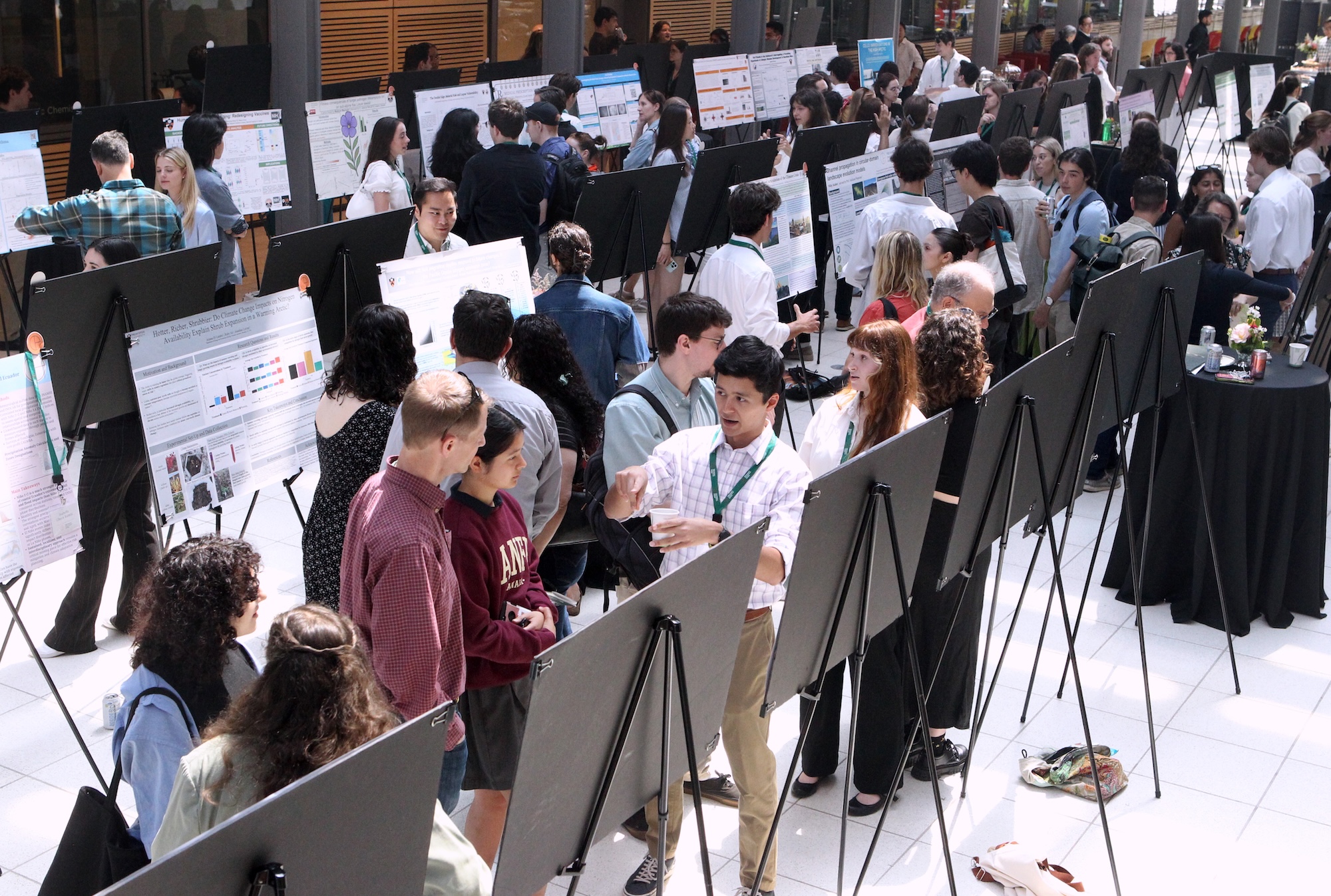
Hundreds from across Princeton gathered on April 30 to showcase students’ environmental research at the High Meadows Environmental Institute’s twelfth annual Discovery Day. Held each year since 2012, Discovery Day is a multidisciplinary poster show celebrating undergraduate and graduate student research on environmental topics. The event provides an opportunity for students to display and discuss their research methodologies and results, exchange perspectives, and identify potential solutions to pressing environmental challenges.
This year’s poster show featured 74 students from 24 academic departments, mentored by 67 Princeton faculty. The research topics were categorized into seven focal themes: Biodiversity and Conservation, Climate and Environmental Science, Environmental Policy and Society, Water and the Environment, Sustainable Agriculture, New Energy Future, and Health and Disease.
Student research projects examined a diverse range of questions across natural sciences, social sciences, engineering and the humanities. Topics included the seasonal diet variation in white-tailed deer, COVID-19’s impact on air pollution and asthma, using remote sensing to understand methane emissions from rice paddies, and the future of federal environmental regulation.
The profiles below provide a sampling of the dozens of student research projects featured at Discovery Day 2025. A complete listing of participants and projects is available in the event program.
Trang Ngo ’25, Ecology and Evolutionary Biology / ENV minor
Adviser: Mary (Cassie) Stoddard, Professor of Ecology and Evolutionary Biology
“Picky Eater? How Weather and Nectar Quality Affect Broad-tailed Hummingbirds’ Foraging Patterns”
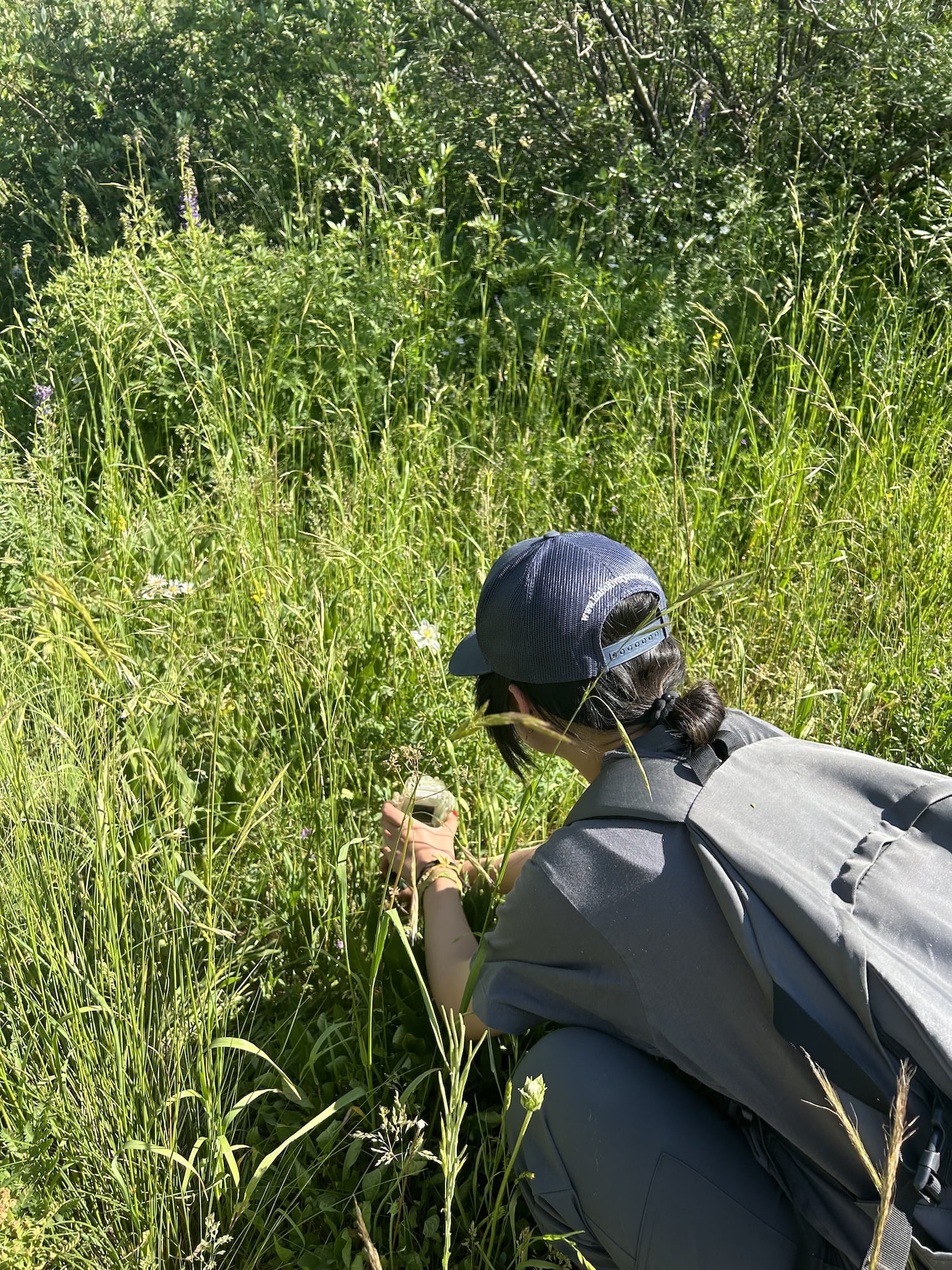
Senior Trang Ngo studied how hot weather and nectar quality affect the foraging behavior of broad-tailed hummingbirds. With support from HMEI, Ngo spent the summer of 2024 collecting data at the Rocky Mountain Biological Laboratory (RMBL) in Gothic, Colorado, where many hummingbirds spend their summers breeding and raising young. Ngo had previously conducted fieldwork there as an HMEI intern in the summer of 2023. “It’s a beautiful place, very remote, with lots of wildflowers and hummingbirds flying around,” said Ngo. “It was very cool to be immersed in the research there.”
At the field station, Ngo measured the nectar concentration and volume produced by four plant species — two common food sources for hummingbirds, and two of which the birds visit less often. “Typical hummingbird flowers are preferred by the birds due to their shape, which makes it easier for the birds to feed, and also because their nectar tends to be higher in volume and more dilute, which makes it easier for the birds to drink,” explained Ngo. By pairing this data with daily temperature records, she showed that typical hummingbird flowers produced higher volumes of nectar on hot days. In contrast, atypical hummingbird flowers produced smaller volumes of more concentrated nectar on hot days. “You would expect to see more visitation to typical hummingbird flowers on hotter days to offset water loss at higher temperatures, but my analysis showed that as temperature increases, they actually make fewer visits to typical flowers,” said Ngo. “I hypothesize that this might be because the birds spend less time flying from flower to flower on hot days.” Ngo’s work will help us understand how a warming planet, and the associated changes in plant distributions and flowering patterns, might impact hummingbirds in future.
Helena Frudit ’25, Mechanical and Aerospace Engineering / ENV minor
Adviser: Eric Larson, Senior Research Engineer, Andlinger Center for Energy and the Environment
“A High-resolution Bioenergy Sector Model for Net-Zero Brazil”
For her senior thesis, Helena Frudit created a model to cost-optimize the bioenergy sector’s supply chain in Brazil. The model is part of the newly launched Net-Zero Brazil project, a collaboration between Princeton and Brazilian researchers that aims to provide viable pathways for the country to achieve net-zero emissions by 2050. Net-Zero Brazil follows in the footsteps of Princeton’s Net-Zero America project, spearheaded by Frudit’s advisor Eric Larson, which was central in informing Biden’s Inflation Reduction Act. Frudit previously worked with Larson as an HMEI intern in 2023, investigating solar rooftop potential in the United States.
To inform the model for this thesis, Frudit collected country-wide data on the costs to produce bioenergy crops, convert the crops into biofuels, and transport both the crops and biofuels. “Gathering the data was probably the most challenging part of my work, because we needed a very fine spatial resolution, so it was difficult to get the necessary breadth and depth of data at the same time,” said Frudit.
As part of the project, she visited Brazil in January 2025, with support from HMEI, to meet with collaborators in San Paulo. “Traveling to Brazil was a pivotal part of the project, because I was able to validate everything I had, as well as obtain more data,” said Frudit. As a test case, she applied the model to Mato Grosso do Sul, a state in a state in central-west Brazil. “Mato Grosso do Sul is interesting because it has a huge bioenergy potential — there’s a lot of agriculture there — and it also has the Pantanal, the largest wetlands ecosystem in the world, so it offers a good analysis of the tradeoffs between conservation policies and expanding bioenergy,” said Frudit. This test case showed that bioenergy activity growth should be concentrated in the Center-South of the state and predicted that allowing agricultural expansion into the Pantanal would not bring significant financial benefits. “It’s a pretty strong case for conservation policy of the wetlands, mainly because of the far distances from Pantanal to demand and conversion facilities,” said Frudit. “Now my work is ready to be integrated into the full energy-system optimization model under development for the Net-Zero Brazil project.”
Alyssa Ritchie ’25, Chemistry / ENV minor
Adviser: Michele Sarazen, Assistant Professor of Chemical and Biological Engineering
“Catalytic Degradation of Dyes Using Activated MIL-100(Fe) Metal-organic Framework”
Alyssa Richie ‘25 tested a method to remove and degrade dyes and other pollutants from wastewater—specifically using an iron-based metal-organic framework (MOF). “Globally, around 700,000 tons of dye compounds are produced each year, and these often contain chemicals that are carcinogenic and difficult to degrade,” said Ritchie. “From wastewater, these compounds can end up in natural waters and be harmful to ecosystems and human health.”
As an HMEI intern in summer 2023, Ritchie worked on a light-based method to degrade dye compounds in wastewater. For her senior thesis, she worked on an alternative method for dye degradation based on MOFs—porous compounds with large surface areas that can bind various substances—in combination with the Fenton reaction, a chemical reaction between iron salts and hydrogen peroxide that breaks down compounds like dyes via oxidation. With funding support from HMEI, Ritchie helped synthesize an iron-based MOF called MIL-100(Fe) and then conducted experiments to test its ability to degrade methylene blue and other dyes under different experimental conditions. She showed that activating the MOF by heating it up prior to use improved its ability to both bind and degrade methylene blue. Her experiments also revealed that the method might be more efficient and sustainable with lower levels of hydrogen peroxide. “We found that using higher amounts of hydrogen peroxide actually resulted in more leaching into solution, which suggests that having more hydrogen peroxide present is destabilizing our catalyst,” said Ritchie. “This means that in order to make our catalysts reusable and recoverable, we might want to use lower levels of excess hydrogen peroxide in the future, especially if we were to scale this up for use in real wastewater treatment systems.”

Will Hartman ’25, English / ENV minor
Adviser: Ed Park, Lecturer in Creative Writing and the Lewis Center for the Arts
“Blue Asters: Seeking Novel Articulations of the Climate Crisis”
For his senior thesis, English major Will Hartman didn’t just read novels—he wrote one. Specifically, a novel that explores the violence and emotions of the climate crisis. “Literature, for a long time, has been really important in articulating crisis and processing it as cultural memory,” explained Hartman. “I was interested in taking that concept and spinning it towards the climate crisis, pairing it with my environmental studies minor.” In writing the novel, Hartman drew influence from authors of modern fiction, elegy, ecocentrism, and nature writing, including Virginia Woolf, John Keats, Percy Shelley, Timothy Clark, Anne Carson, and Marilynne Robinson. With support from HMEI, Hartman also traveled to Greece, London, and Rome to conduct research for his writing. The novel takes place on a fictional Mediterranean island called Madreselva, and tackles the themes of family betrayal, resource extraction, and the moral contradiction between performing actions for personal gain at the expense of the community and planet. Hartman also explores the concept of “slow violence,” which was developed by HMEI faculty member Rob Nixon. “Because the violence involved in the climate crisis is so slow, and because we’re a culture addicted to immediacy and short attention spans, it’s hard to articulate and push people into action,” said Hartman. “I was interested in thinking about the ways that literature might be particularly suited to articulate the climate crisis in terms of its nuance, but also in terms of how it can engage with time. I wanted to write a story that would stand up on its own and be fun to read, but that would spin into an argument about community and finding political direction.”

Madison Machado ’25, Ecology and Evolutionary Biology / ENV minor
Adviser: C. Jessica Metcalf, Professor of Ecology and Evolutionary Biology and Public Affairs, Princeton School of Public and International Affairs
“Fitness Consequences of the Fungal Pathogen Melampsora lini on Sub-alpine Flax Linum lewisii”
Senior Madison Machado studied rust fungus, a common plant pathogen that causes damage to the global food supply and whose impact is expected to worsen with climate change. Machado examined the fungus’ impact on the growth and reproduction of sub-alpine flax plants growing at different levels of elevation in the Rocky Mountains. “The rust fungus that I studied is one of about 7,800 rust fungus species, and many of those infect agricultural plants, including flaxseed, linseed, and some cereals,” said Machado. “By modeling what the rust is doing in this wild system, we can get a better picture of how it might behave and impact plants that are important to global food supply.”
With support from HMEI, Machado traveled to the Rocky Mountain Biological Laboratory (RMBL) in Gothic, Colorado in the summer of 2024 to collect data comparing the fitness and fertility of infected and healthy flax plants. She showed that fungal infections were associated with smaller plants that produced fewer flowers and seeds. Surprisingly, however, infected plants were more likely to survive the winter. “My hypothesis, which needs a little bit more research to confirm, is that plants might be investing in overwinter survival instead of investing in defending against the disease, because winters in Colorado are very harsh,” said Machado.
Thanks to HMEI, this was Machado second stint working at the Rocky Mountain Biological Laboratory; she had also interned there in the summer of 2023, and was keen to return. “I’d recommend anyone who is interested in an internship or a senior thesis to consider going to RMBL because of the amazing opportunities there,” said Machado. “It’s a beautiful place to do science, and you get to be surrounded by an amazing research community.”

Kat McLaughlin ’25, Anthropology / ENV minor
Adviser: Jerry Zee, Assistant Professor of Anthropology and the High Meadows Environmental Institute
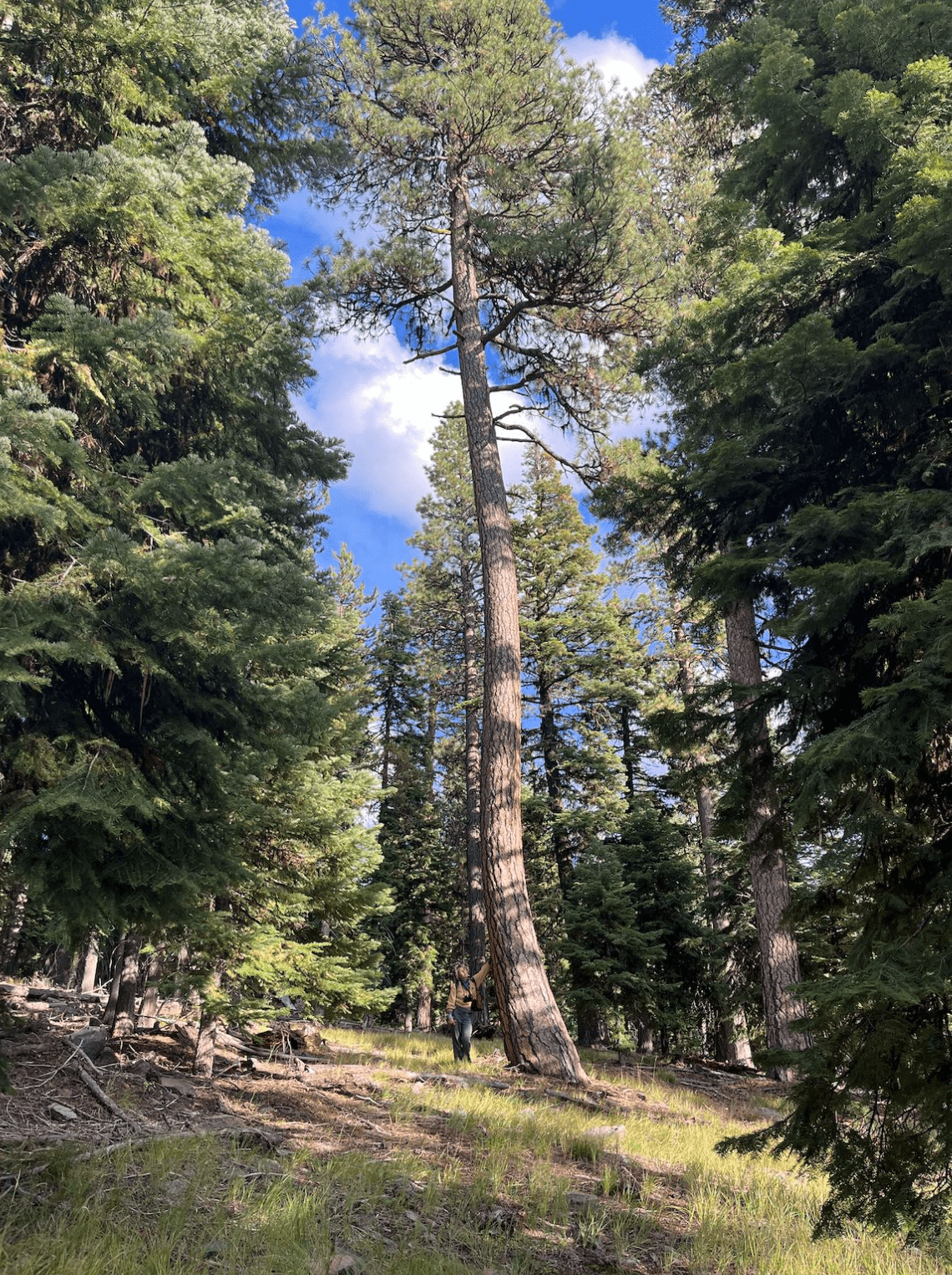
“Cultures of Work and Environmental Belief Systems: An Ethnography of Forest Activists in Oregon”
Kat McLaughlin ’25 explored how beliefs and priorities are shifting in forest activists in Oregon. “I was interested in environmental belief systems and how and why people come to do the work that they do,” said McLaughlin, who is majoring in Anthropology, and whose adviser, Jerry Zee, is a member of HMEI’s core faculty. “I wanted to know what the current forest activism landscape looks like, how it has been affected by the past, and how it is pushing towards the future.”
Back in 2023, as an HMEI summer intern, McLaughlin had examined a different environmental anthropology question: investigating how community members in southern Pennsylvania responded to nearby solar development.
For her thesis, again with HMEI support, McLaughlin traveled to Oregon in August, September, October and December of 2024 to meet with two activist groups, Portland Forest Community Organizers, an urban-based nonprofit, and For the Forests, a nonprofit in eastern Oregon. In addition to conducting ethnographic interviews, she spent four days camping with activists and attended a conference in Portland.
Both groups were formed in the 90s but have different priorities, in part because old-growth logging has slowed in the Portland area but remains an ongoing issue in eastern Oregon. “The big thing that I conceptualize is the lingering of radical activism within forest activism,” said McLaughlin. “There’s tension building in the conservation and forest defense world between professionalism and activism. Older people who were involved in radical activism still think about working against logging as a fight, rather than work, which means a greater sense of personal sacrifice, stronger social ties between people doing that work, more commitment, and more trust. In contrast, newer forest activists are prioritizing inclusivity and trying to get more people involved with less individual commitment and more community partnerships.”