




Decoding Hummingbird Communication
“I become a morning person in the field,” said Jessica Wang, ’26. “I’ll get up for the birds.”
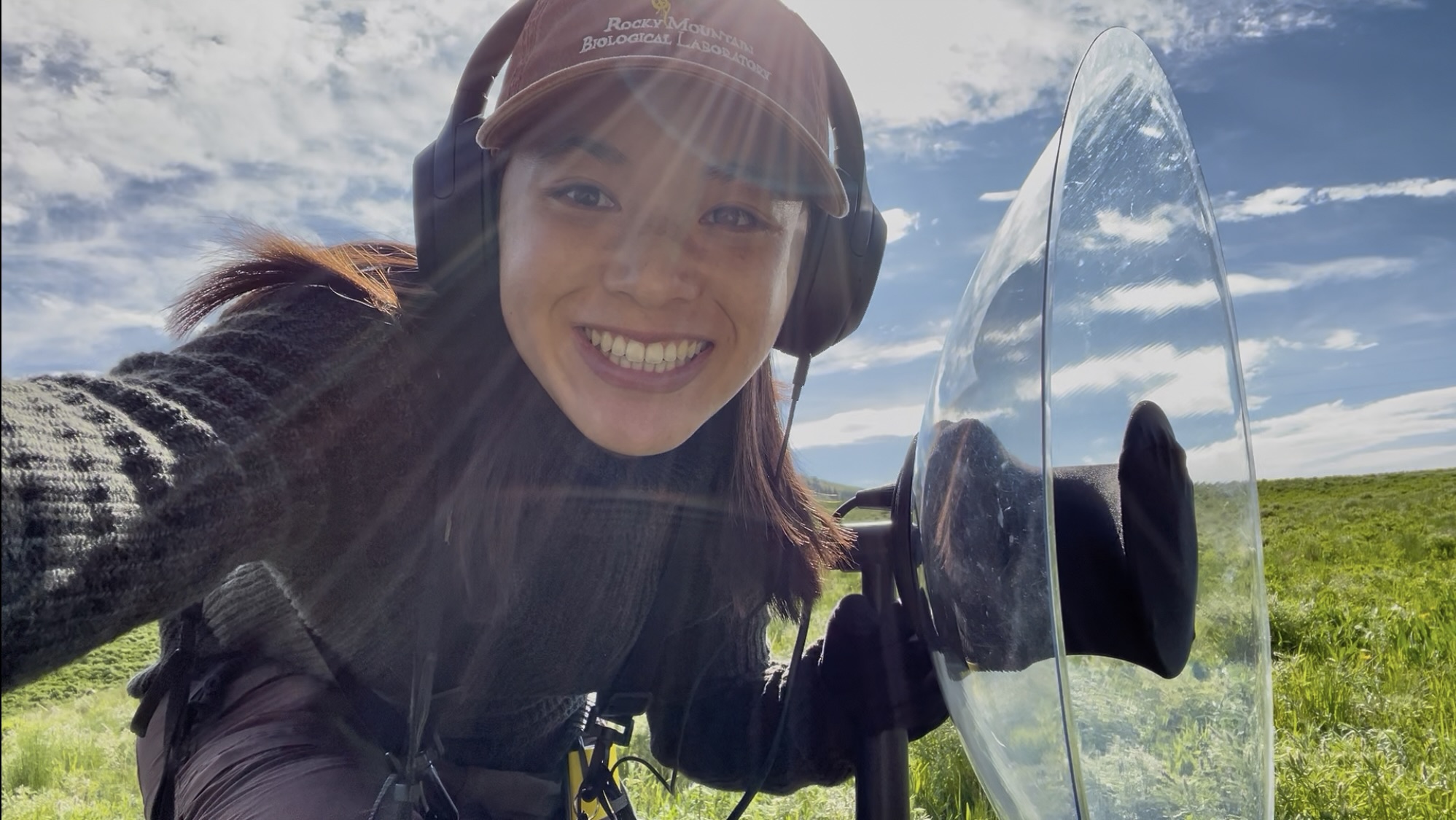
For her senior thesis, Wang investigated vocal communication in broad-tailed hummingbirds (Selasphorus platycercus) in the Rocky Mountains, Colorado. This fieldwork was made possible by the Becky Colvin Memorial Award, which is presented each year by HMEI and the Department of Ecology and Evolutionary Biology (EEB). Since 1999, more than 50 Princeton students have received funding for senior thesis field research through the Colvin Award. Wang won the award to fund her fieldwork in the Rocky Mountains, where she investigated a unique mode of vocal communication in hummingbirds.
Broad-tailed hummingbirds have lost the ability to sing. Instead, they communicate by chattering, making humming noises with their wing and tail feathers, and through short, monosyllabic vocalizations—onomatopoeically dubbed “chip” calls. Compared to birdsong, little is known about chip calls. Wang wanted to know how hummingbirds use chip calls in different contexts—such as while they were defending territories, foraging for food, and courting each other.
“Broad-tailed hummingbirds are a key pollinator species in subalpine habitats, but they pass through a lot of cities during their annual migration,” said Wang. “Deciphering how they communicate in their natural habitat is important for understanding how noise pollution might impact them when they’re passing through human landscapes.”
With support from the Colvin Award, Wang traveled to the Rocky Mountain Biological Laboratory in the summer of 2025 to observe and record hummingbird behavior. She spent the summer walking and biking around the subalpine field site, observing hummingbird territories and recording hummingbird chip calls in different contexts.
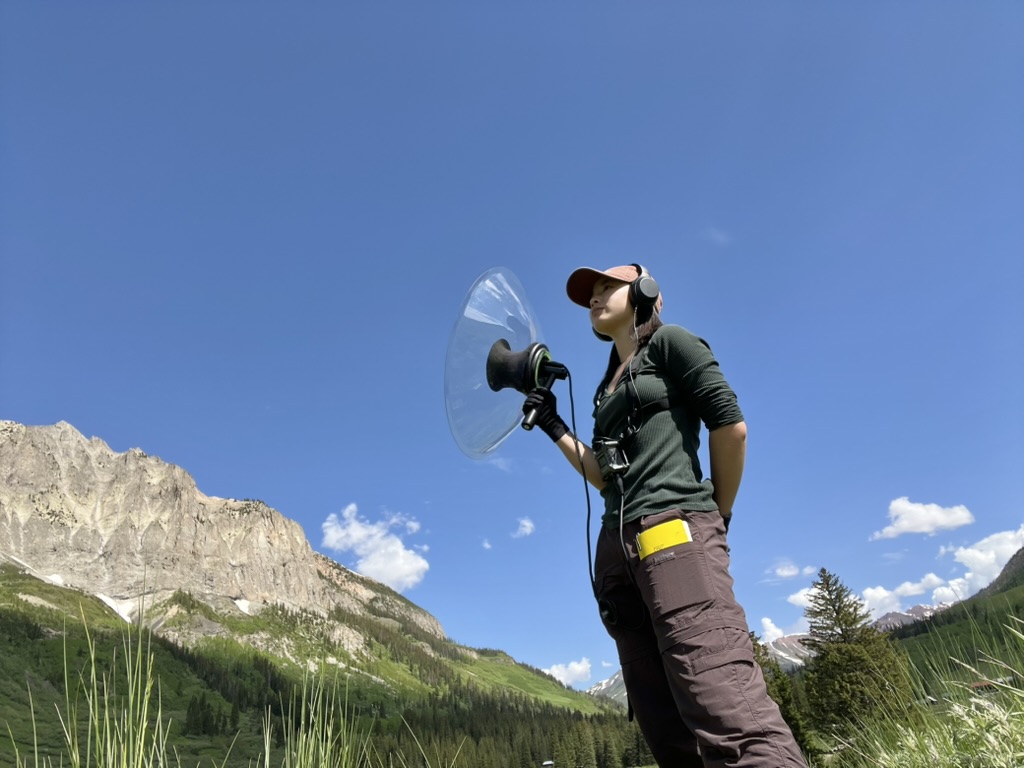
“Working with Jessica was a real treat,” said Mary (Cassie) Stoddard, Wang’s senior thesis advisor and Professor of Ecology and Evolutionary Biology. “She brought energy, creativity, and an interest in bioacoustics to the project, and she even developed a custom computer program to analyze the vocalizations she recorded in the field.”
When she analyzed her recordings, Wang identified rhythmic patterns that showed up repeatedly. Though the hummingbirds sometimes emitted a single “chip”, they often strung 10 to 15 “chips” together in a sequence. Within those sequences, Wang noticed that the birds would frequently group two or three chip calls in close succession—chip-chip or chip-chip-chip.
“These double and triple acoustic units occurred across different behavioral contexts, but they were more prevalent during female courtship, male pursuit, and male vigilance,” said Wang. “It seems like these birds have learned to use rhythm to encode information about how excited or how angry they are, almost like a metric of emotional arousal.”
As an unplanned bonus, Wang also compared chip calls between broad-tailed hummingbirds and a closely related species, the rufous hummingbird (Selasphorus rufus).
“In late July, the rufous hummingbirds arrived, and our territories got thrown into complete chaos because they were zipping around and furiously fighting the broad-tails— it was like a little turf war going on out in the mountains,” said Wang. “I made lemonade out of lemons by recording rufous hummingbirds instead.”

Like broad-tailed hummingbirds, rufous hummingbirds can’t sing, but Wang showed that they haven’t developed their use of chip calls to the same extent. Compared to broad-tailed hummingbirds, rufous hummingbirds made chip calls less frequently and used less complex rhythmic patterns.
“These two hummingbirds are from the genus, but it seems like broad-tailed hummingbirds have evolved this rhythmic pattern to communicate— kind of like a Morse code—that rufous hummingbirds haven’t developed,” said Wang.
Wang already had significant research experience under her belt when she joined Stoddard’s lab in her junior year. She spent her freshman summer doing computational chemistry research at Princeton, and divided her sophomore summer between conducting climate research in Copenhagen and Greenland and doing field research in Panama, with Christina Riehl, Associate Professor of Ecology and Evolutionary Biology.
This fall, Wang is embarking on a Ph.D. at Oxford University, where she will continue to study bird communication.