



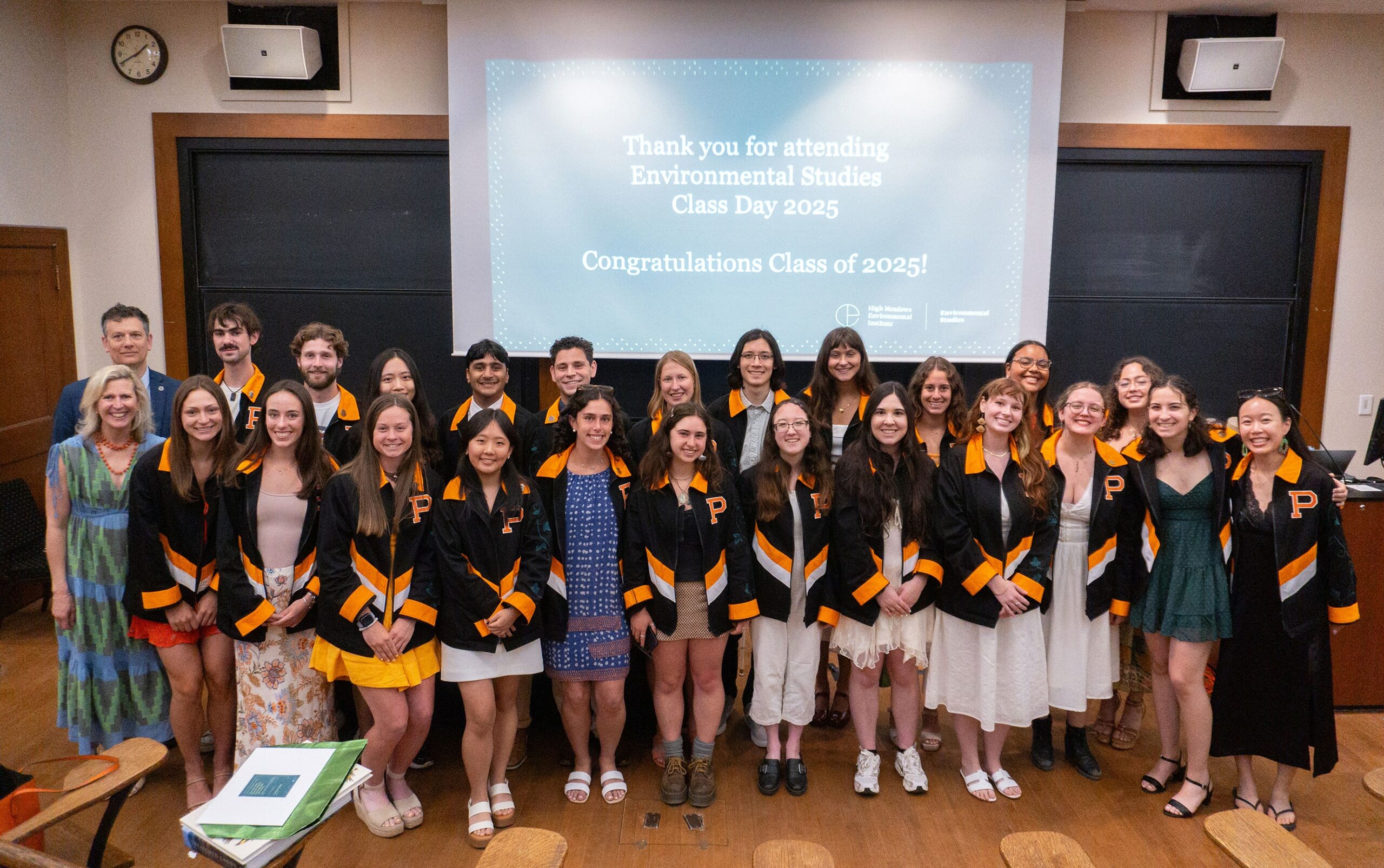

ENV Class Day 2025 honors newest graduates of Princeton’s environmental studies program and celebrates their commitment to environmental research
Students and parents joined faculty, researchers and staff from the High Meadows Environmental Institute (HMEI) and the Program in Environmental Studies yesterday to celebrate the 34 Princeton University seniors from 19 departments who have earned minors in environmental studies (ENV).
Held Monday, May 26, ENV Class Day 2025 recognized these students for their exceptional work throughout their four years at Princeton and especially for the quality and interdisciplinary breadth of their senior thesis research.
Allison Carruth, ENV Program Director and professor of American Studies and HMEI, welcomed the graduates, noted that they are the first cohort to have earned minors in environmental studies, and hailed their academic achievements.
“These students, some of whom I have in my own classes,” said Carruth, “represent the very best of the interdisciplinary scholarship here at the Institute, in their commitment to environmental inquiry and impact. It has enriched our community and communities across the country and far beyond.”
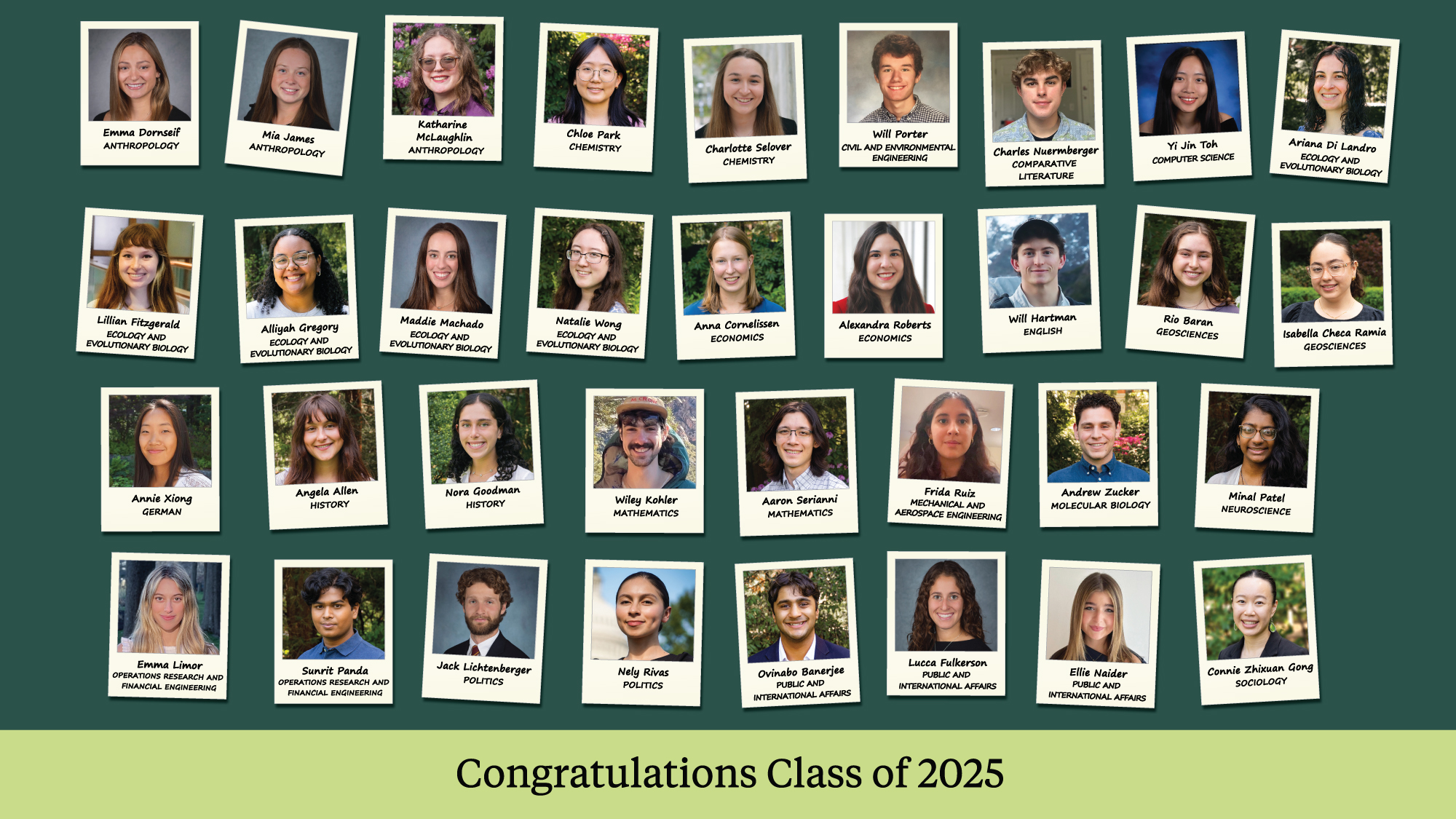
Carruth individually recognized each student who has earned the ENV minor, and then presented prizes for outstanding thesis research and exceptional engagement with environmental studies to eight graduating seniors.
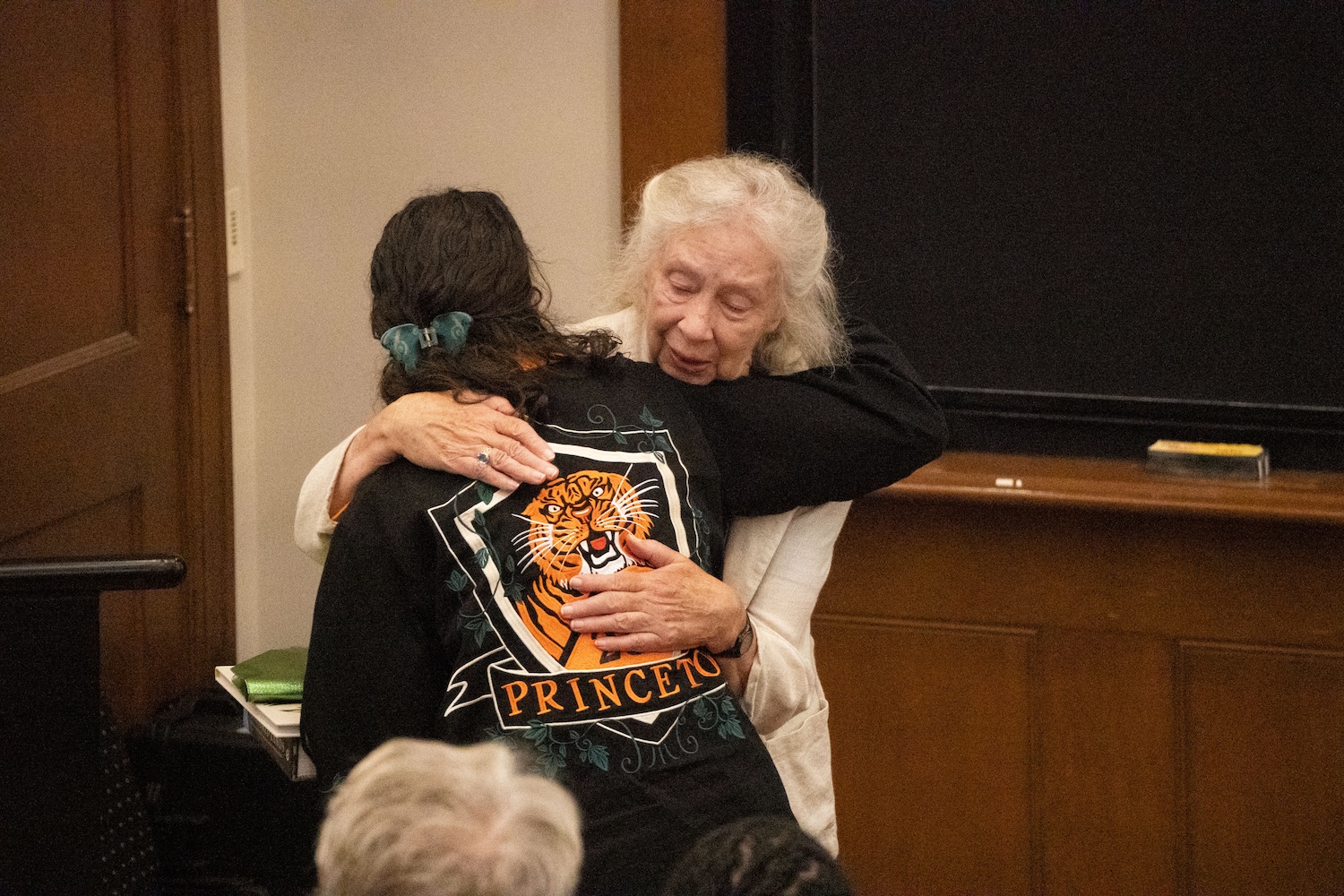
The fifth annual Henry Horn Prize was presented by Elizabeth Horn, widow of the late Henry Horn, professor of ecology and evolutionary biology, emeritus, and founding director of what was then called the Program in Environmental Studies. This prize recognizes the senior who has produced the best visual presentation of their independent research for a broad audience.
Ariana Di Landro in ecology and evolutionary biology received the prize for her poster presenting findings of her thesis, “Hotter, Richer, Shrubbier: Do Climate Change Impacts on Nitrogen Availability Explain Shrub Expansion in a Warming Arctic?” which examines how changing arctic plants may signal a changing climate.
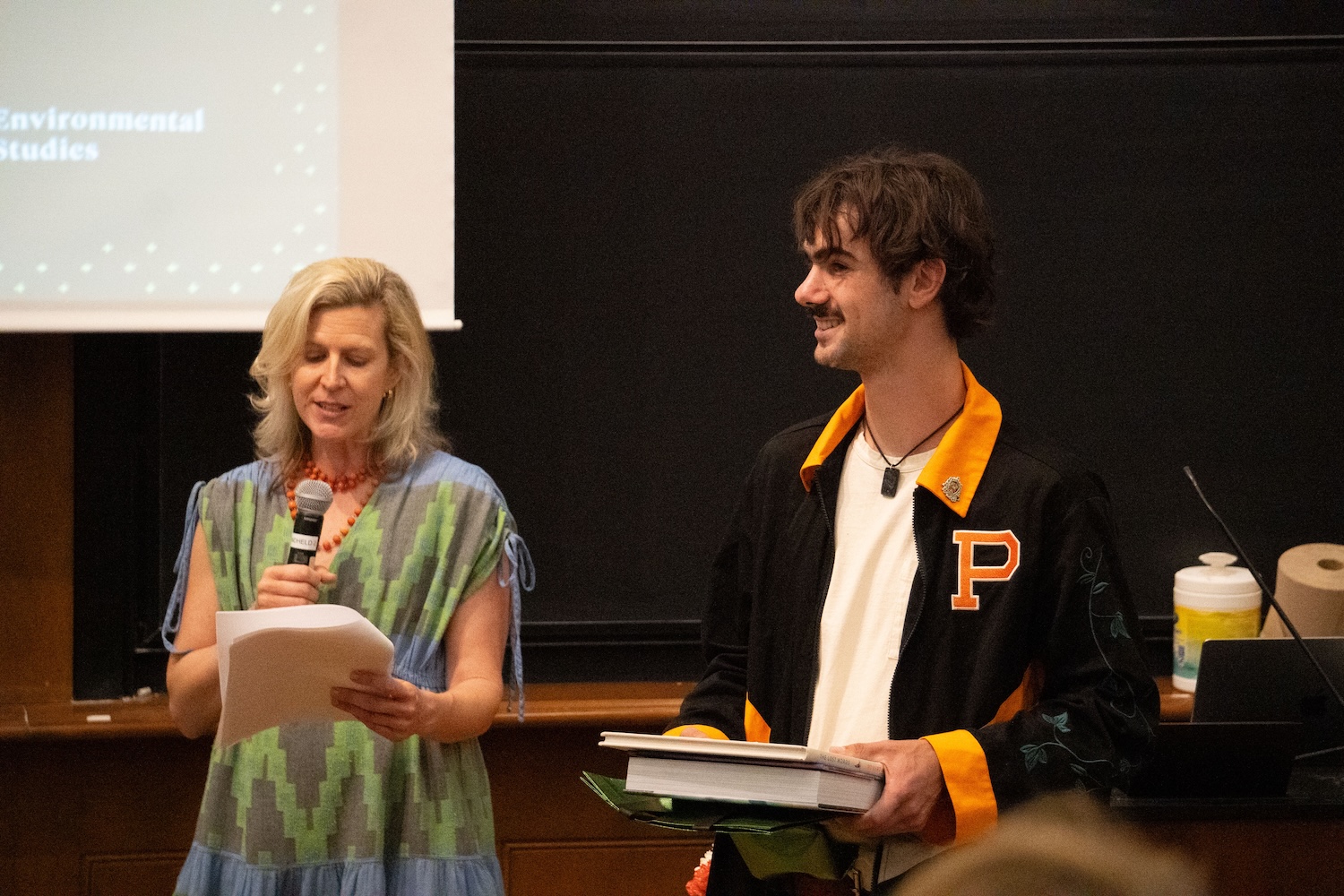
Next, Carruth presented Environmental Studies Book Prizes to four students for exceptional research and demonstrated ability to communicate their work and its significance. She presented Book Prizes to two students in the Natural Sciences and to two students in the Social Sciences.
Wiley Kohler in Mathematics received a Book Prize in Natural Sciences for his thesis, “Channel Propagation, Branching and Self-similarity in Circular-domain Landscape Evolution Models,” which examines the dynamics of valley formation by fluvial erosion.
Wiley’s adviser, Amilcare Porporato, explained that, “By improving a computer code for the equations of water flow and landscape evolution and performing extensive simulations of the related erosion patterns, [Wiley] could characterize the statistical similarity of river branching at different spatial scales. Additionally, through sophisticated linear stability analysis of small perturbations he was able to quantify for the first time the critical rate of erosion necessary for onset of valley formation in circular geometry, for example, around the top of a mountain or in compact islands. These results help improve our ability to simulate the evolution of topographic landscapes for earth modeling purposes.”
Madison Machado in ecology and evolutionary biology received a Book Prize in Natural Sciences for her thesis, “Fitness Consequences of the Fungal Pathogen Melampsora lini on Sub-alpine Flax Linum lewisii,” which explores how a fungal pathogen changed its host plant’s fitness, with potentially significant implications for agriculture.
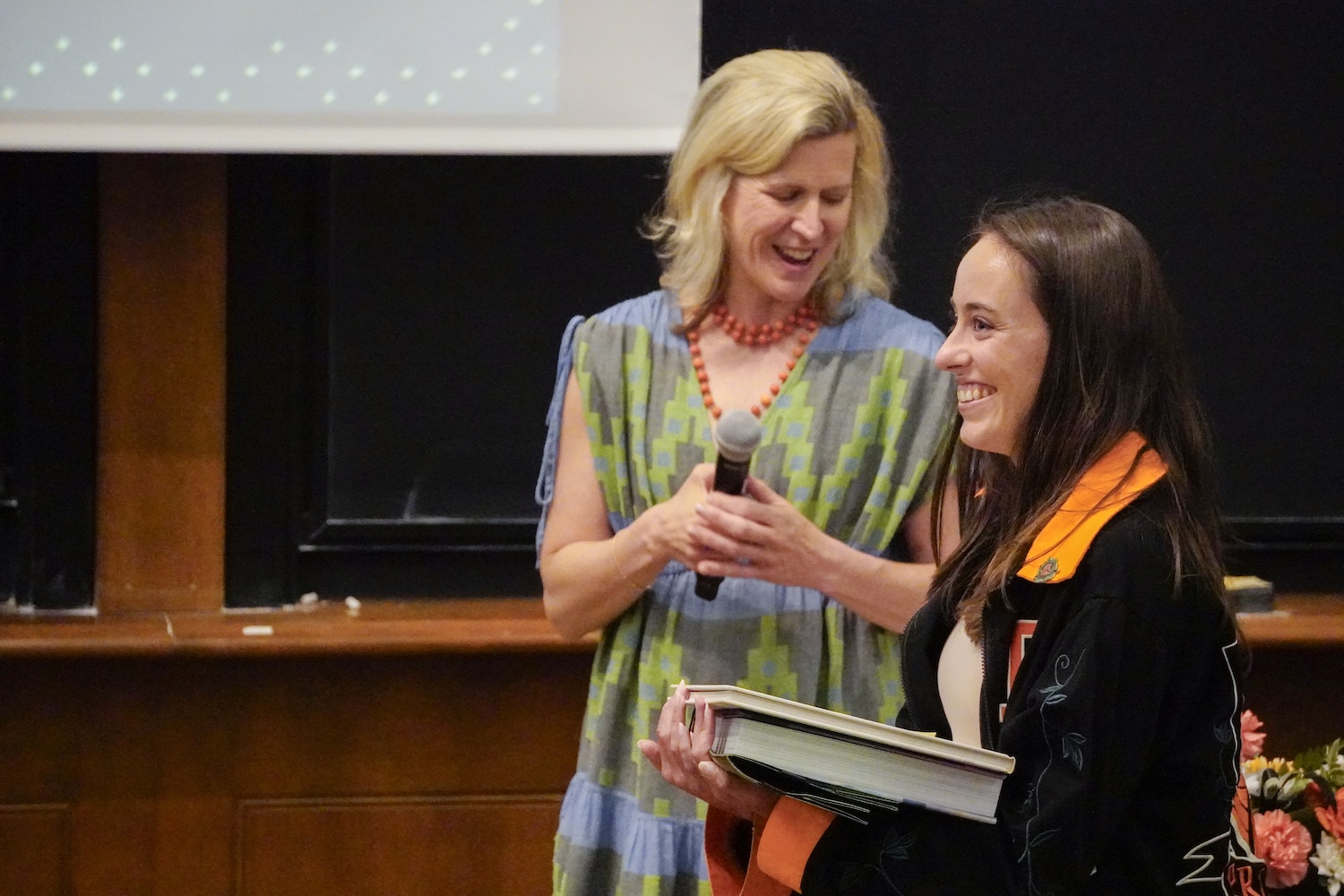
Madison’s adviser, Jess Metcalf, praised her two years of challenging fieldwork at the Rocky Mountain Biological Field Station and the way that she “blended careful statistical analysis with demographic modeling—either of which alone would have represented a striking technical feat.” She called Maddie “a pleasure to work with throughout: thoughtful, energetic and never daunted.”
Lucca Fulkerson in Public and International Affairs received a Book Prize in Social Sciences for her thesis, “Protecting the Land and Restoring Historical Rights: An Environmental Justice Story in Colorado’s San Luis Valley,” which examines a decades-old land dispute.
Lucca’s adviser, Frederick Barton, said that, “with Lucca, it all starts with a deep love for a place and its people,” noting that her own ancestral ties to Costilla County, Colorado inspired the “beautifully written” thesis. He went on to explain, “Lucca captures the law, the traditions and the culture in a range of research to produce a compelling and scholarly piece—calling forth the need to build trust, grow mutual respect and understand the practices of all. She is realistic about the challenge, fair in describing the hurdles and hopeful for a resolution.”
Kat McLaughlin in Anthropology received a Book Prize in Social Sciences for her thesis, “Old Growth and New Roots: The Shifting Landscape of Forest Defense in Oregon.”

Kat’s adviser, Jerry Zee, called her thesis “a beautiful and careful account of an environmental movement at a crucial inflection point that puts generations of activists in the delicate space of negotiating the legacies and enduring ethical and political inheritances of radical environmental activism in the 1990s.” He added, “Katharine’s thesis situates the future of forest defense as not only a set of contentious debates over how to interpret the past of the movement, but also within the ways that gentrification, professionalization, and economic precarity together raise important material and conceptual problems for intergenerational activist organizations who now find that they have increasingly distinct understandings of nature, politics, and work. It is a clear and empathetic analysis of the political, social, and economic landscape awaiting young would-be environmental activists, and has important insights on how to sustain environmentalist movements when it seems everything about the world they are addressing has changed.”
Next, Carruth presented the Environmental Studies Senior Thesis Prize, awarded annually to a senior in the ENV Program who has written the best thesis in the broad area of Environmental Studies. This year’s Environmental Studies Senior Thesis Prize was awarded to Lillian Fitzgerald in ecology and evolutionary biology for her thesis, “Breaking Barriers: An Analysis of Dam Removal and Chinook Salmon Recovery on the Klamath River,” which investigates the controversial history of dam building and its consequences for both salmon populations and the indigenous people who have depended on the salmon for generations.
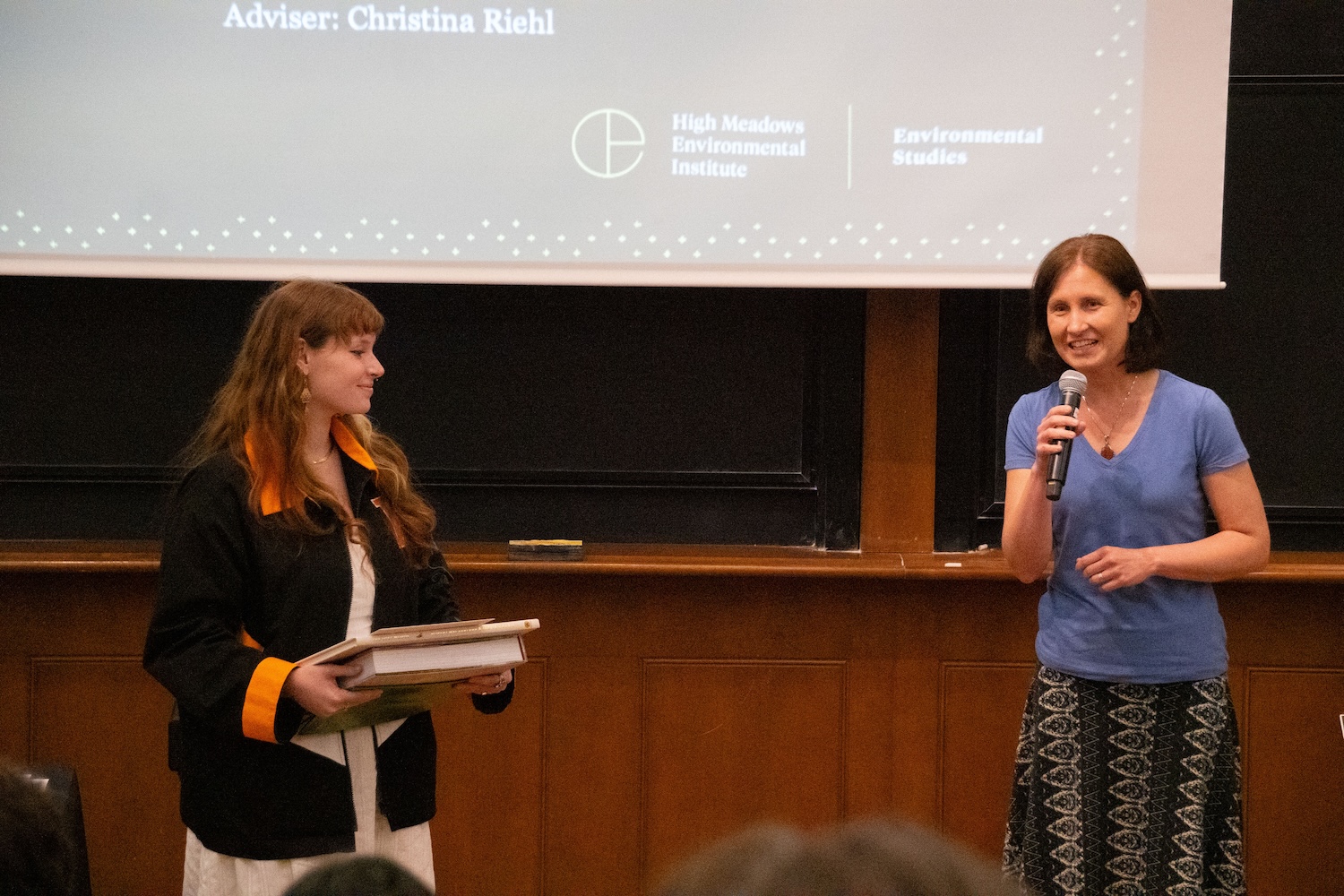
Lillian’s adviser, Christina Riehl, called her work “a beautiful investigation,” and explained that, for her fieldwork, “Lillian went to Oregon and interviewed members of the indigenous community and local stakeholders about this history. She wrote a very compelling thesis about the role of those indigenous voices, emphasizing them in a way that I think hasn’t been told before.” Riehl noted that Lillian’s thesis reads like both a thriller and investigative journalism.
Connie Gong in Sociology received the Peter W. Stroh ’51 Environmental Senior Thesis Prize for her thesis, “Ain’t Nothing Easy ‘Bout Being in Angola: Farm Labor and Punishment at the Louisiana State Penitentiary.”
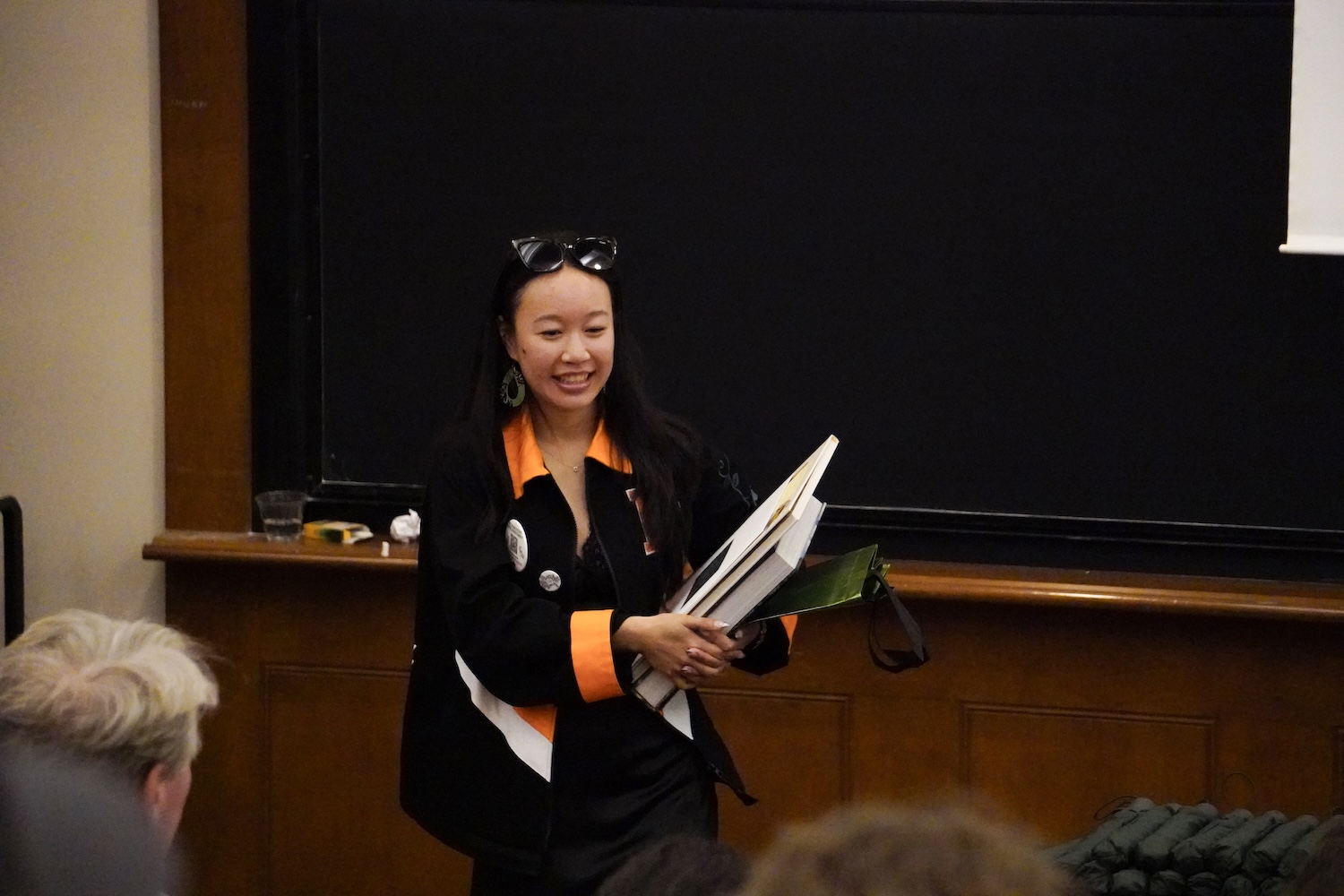
Connie’s adviser, John Robinson III, described her thesis as extraordinary and compelling. He marveled at her commitment to the hard work of bearing witness through 26 interviews with men who were formerly incarcerated at Angola, an 18-day field visit to the site, and extensive archival research into the “grim but illuminating history as a slave plantation remade over the years into a maximum-security prison farm.” He praised the work as a “truly original contribution… that helps us to connect the dots between things that may seem unrelated—in particular, between punishment, labor and the environment.”

Patrick Newcombe in ecology and evolutionary biology received the T. A. Barron Environmental Leadership Prize, which honors a member of the senior class who has distinguished themself by showing exceptional dedication to environmental concerns in their classes and independent academic work, as well as by leading and encouraging activities among fellow students and community members.

Cassie Stoddard, a faculty member in the Department of Ecology and Evolutionary Biology, called Patrick’s work “staggering,” noting that, in addition to his remarkable research, Patrick has been “indefatigable in his efforts to make the campus a safer and more environmentally friendly place for birds. I consider him to be one of my most vital collaborators on these efforts.” She explained that, as President of the Princeton Birding Society, Patrick played a crucial role in plans to add bird-friendly coatings onto campus windows, which will greatly reduce collisions impacting migrating birds on campus. She called Patrick “exceptionally energetic, thoughtful and talented,” adding, “I cannot think of a more deserving recipient of the T. A. Barron Prize for Environmental Leadership.” She concluded by thanking him for all he has done “for the Princeton community—and for the birds.”
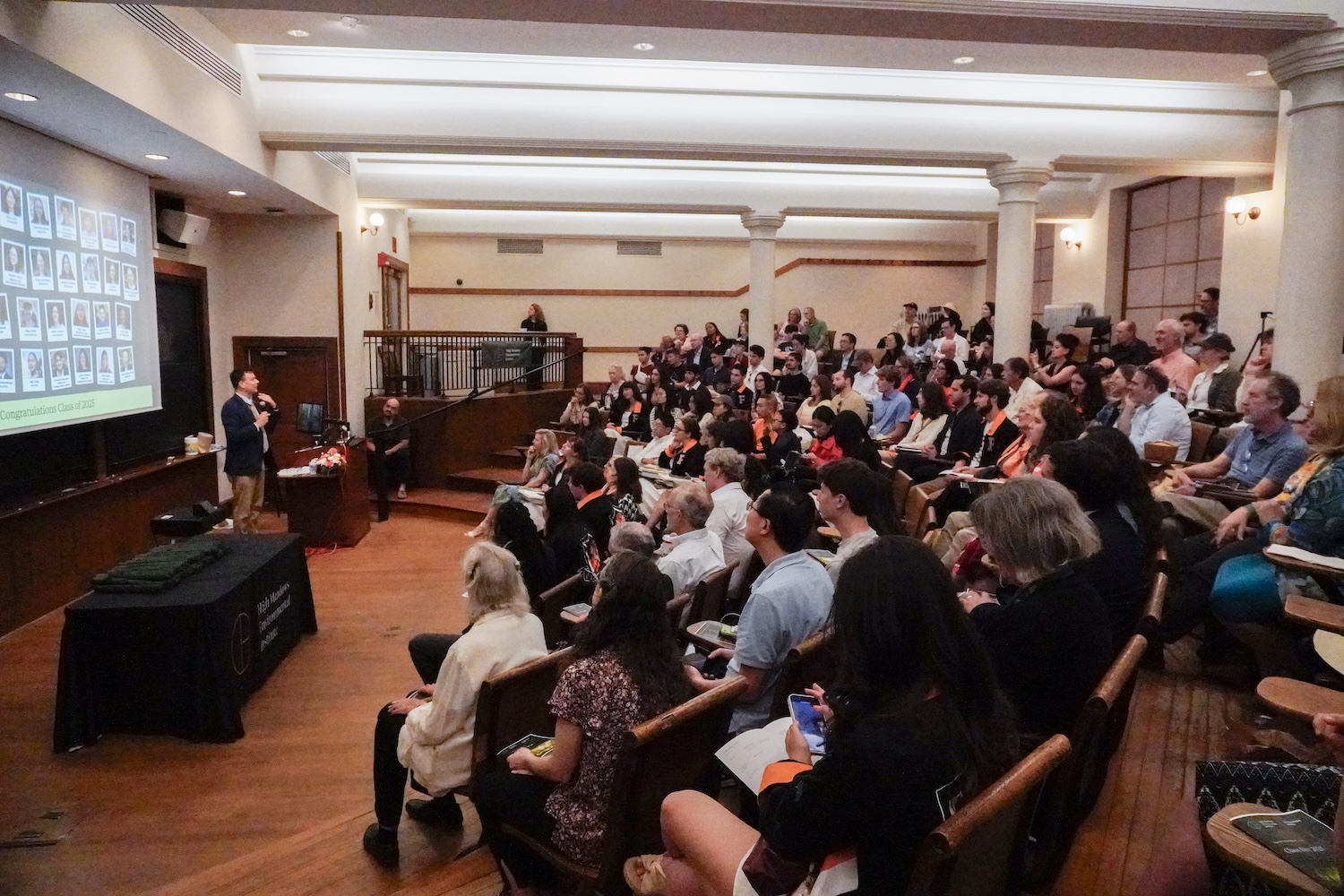
HMEI Director Gabriel Vecchi, professor of geosciences and the High Meadows Environmental Institute, concluded the ceremony by congratulating the day’s graduates on their achievements, and reminding them that, while their undergraduate studies are complete, their exciting work ahead is only just beginning. “Leave your mark in excellence,” he said to them. “Continue what you’ve done.”
HMEI Class Day Awards and Prizes
T. A. Barron Environmental Leadership Prize
The T. A. Barron Prize for Environmental Leadership is awarded annually to the senior who has demonstrated exceptional dedication to environmental concerns in their classes and independent academic work, as well as by leading and encouraging activities among fellow students and in the community at large.
 Patrick Newcombe, Ecology and Evolutionary Biology
Thesis title: Spatial Patterning of Bird Diversity by Termite Mounds Across a Human-modified African Savanna Landscape
Thesis adviser: David Wilcove, Professor of Ecology and Evolutionary Biology and Public Affairs and the High Meadows Environmental Institute
Peter W. Stroh ’51 Environmental Thesis Prize
The Peter W. Stroh ’51 Environmental Senior Thesis Prize is awarded annually to a member of the senior class who has written the best thesis on an environmental topic.
 Connie Gong, Sociology
Thesis title: “Ain’t Nothing Easy ‘Bout Being in Angola”: Farm Labor and Punishment at the Louisiana State Penitentiary
Thesis adviser: John Robinson III, Assistant Professor of Sociology
Environmental Studies Senior Thesis Prize
The Environmental Studies Senior Thesis Prize is awarded annually to a senior in the Environmental Studies Certificate Program who has written the best thesis in the broad area of Environmental Studies.
 Lillian Fitzgerald, Ecology and Evolutionary Biology
Thesis title: Breaking Barriers: An Analysis of Dam Removal and Chinook Salmon Recovery on the Klamath River
Thesis adviser: Christina Riehl, Associate Professor of Ecology and Evolutionary Biology
Environmental Studies Book Prizes
The Environmental Studies Book Prize recognizes seniors for outstanding senior thesis research and the ability to communicate the results and significance of their work.
NATURAL SCIENCES
 Wiley Kohler, Mathematics
Thesis title: Channel Propagation, Branching and Self-similarity in Circular-domain Landscape Evolution Models
Thesis adviser: Amilcare Porporato, Thomas J. Wu ’94 Professor of Civil and Environmental Engineering; Professor of Civil and Environmental Engineering and the High Meadows Environmental Institute
 Madison Machado, Ecology and Evolutionary Biology
Thesis title: Fitness Consequences of Fungal Pathogen Melampsora lini on Sub-alpine Flax Linum lewisii
Thesis adviser: C. Jessica Metcalf, Professor of Ecology and Evolutionary Biology and Public Affairs, Princeton School of Public and International Affairs
SOCIAL SCIENCES
 Lucca Fulkerson, Public and International Affairs
Thesis title: Protecting the Land and Restoring Historical Rights: An Environmental Justice Story in Colorado’s San Luis Valley
Thesis adviser: Frederick Barton, Lecturer in Princeton School of Public and International Affairs
 Kat McLaughlin, Anthropology
Thesis title:Old Growth and New Roots: The Shifting Landscape of Forest Defense in Oregon
Thesis adviser: Jerry Zee, Assistant Professor of Anthropology and the High Meadows Environmental Institute
Henry Horn Prize
Awarded to a senior who has produced the best visual presentation of their independent research for a broad audience. Established in memory of Henry Horn, professor of ecology and evolutionary biology, emeritus, and former director of the Program in Environmental Studies.
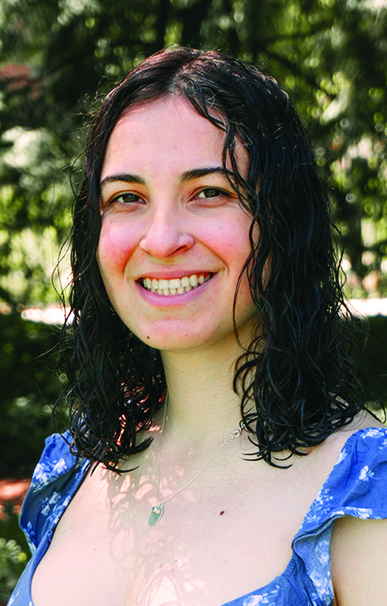 Ariana Di Landro, Ecology and Evolutionary Biology
Thesis title: Hotter, Richer, Shrubbier: Do Climate Change Impacts on Nitrogen Availability Explain Shrub Expansion in a Warming Arctic?
Thesis adviser: Jonathan Levine, J.N. Allison Professor in Environmental Studies; Professor of Ecology and Evolutionary Biology