



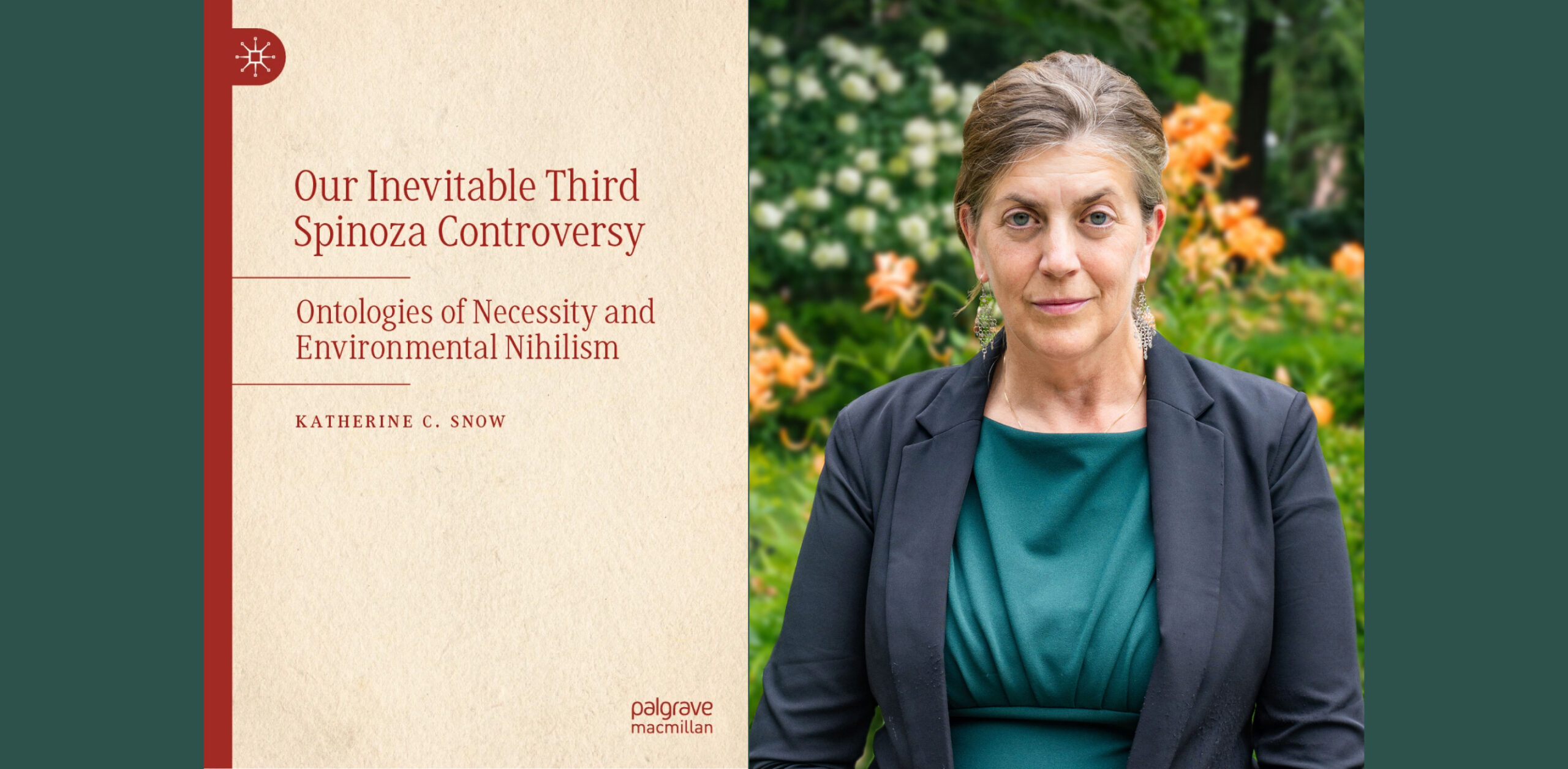

Author Q&A: Katherine Snow’s new book
Katherine Snow is a postdoctoral research associate at High Meadows Environmental Institute (HMEI), the Climate Change and History Research Initiative (CCHRI), and the Max Planck Institute for Geoanthropology in Jena, Germany. Her book “Our Inevitable Third Spinoza Controversy: Ontologies of Necessity and Environmental Nihilism” was published in February 2026 by Palgrave Macmillan.
How did you get the idea for this project?
I think in general, like many other people concerned with the state of the environment, I am always drawn to the question of how and why the “enlightened” West can act in such an “unenlightened” way toward the natural world. In my PhD thesis, I looked at the West’s two-century-long romantic tendency in its conception of nature. Though many people tend to think of the romantics as laying the groundwork for positive outcomes for our treatment of nature, I found that the German romantic notion that our rational theories can be truly “one” with a singular, infinite, monistically understood “Nature” leads to many problems, both logical and environmental. I also found that Western scientific naturalism truly always has been, and still is, based on German romantic conceptions of just this kind. There was a compelling episode of resistance to this basic dominant trajectory just as it was first taking shape around 1800, a fascinating series of debates known later as the Spinoza Controversy. Once I was done with the thesis I was drawn back to look again at the Controversy, and specifically to consider a possible environmental interpretation of the forebodings floated by one of its main participants, Friedrich Jacobi.
What unexpected directions did the research take once you started writing?
I wasn’t fully expecting the relevance, the weight, the Spinoza Controversy turns out to carry for explaining how and why we in the West can possess such a depth of scientific knowledge of nature while also constantly converting the external natural world into the domestic, synthetic, and informatic spaces of our own manufacture and control. The Spinoza Controversy took shape for me as no longer just an old argument over the correct use and limits of human logic, a little series of debates confined to a small corner of European time and space, but instead as a living, unresolved, challenge to better and more rigorously understand and then counter the West’s collective willingness to remove and physically annihilate the non-human world and all its resident species to the surface “benefit”, but really the co-annihilation, of our own.
Why should people read this book?
This is not a traditional work of philosophy. It’s meant to challenge us to retrace past steps in our own shaping of our philosophical and scientific conceptions of nature to try to see what these concepts lack, both logically and in terms of their apparent environmental consequences we see all around us today. I think anyone interested in what is happening to the natural world, and even more than this, in what is happening to our ability to reason well about the crisis of environmental vanishing we ourselves have created, will be interested in reading this work.