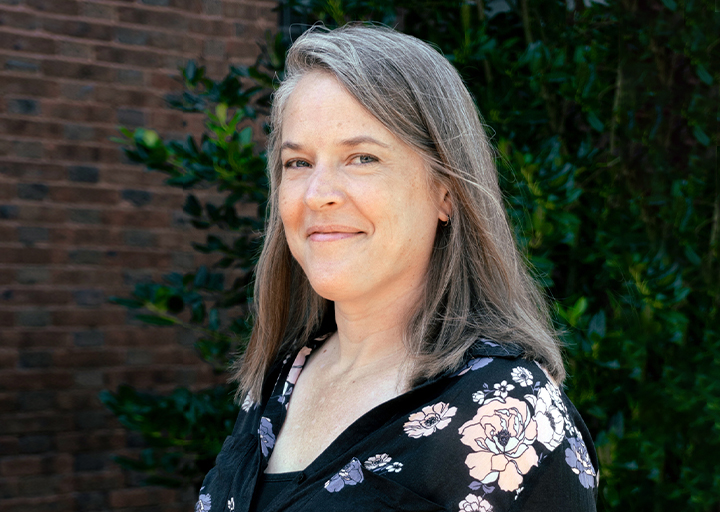
HMEI Faculty Seminar “Fire Responses to Climate Variability and Implications for Fire Management” by Carla Staver
Carla Staver, professor of Ecology and Evolutionary Biology, will present “Fire Responses to Climate Variability and Implications for Fire Management ” in Briger Hall Auditorium, 11 Ivy Lane, or stream it live. Staver is the final speaker in the fall 2025 HMEI Faculty Seminar Series.
Climate variation influences fire activity in the Earth system via multiple mechanisms, including via effects on plant functional (and thus on fuel) types, on vegetation productivity (and thus on the fuel available to burn in fires), and on fuel moisture. How these combine to affect past and potential future trends in fire activity remains poorly constrained. These constraints in turn limit our understanding of how fire can constructively be used as a tool for a range of uses, from conserving fire-dependent biodiversity to decreasing the risk of extreme and damaging wildfires.
This seminar is free and open to the public. Lunch will be available in the Briger Atrium at 11:45 a.m. Click here to stream it live, no registration needed. If you’d like to submit a question for the Q&A, you can do so here.
Directions to Briger Hall.
A recording of the seminar is available on the video archive page.
HMEI Faculty Seminar “Fire Responses to Climate Variability and Implications for Fire Management” by Carla Staver
Event Date
Tue, Dec 2, 2025 ・ 12:15 PM - 1:15 PM
Location
Briger Hall Auditorium, 11 Ivy Lane

Carla Staver, professor of Ecology and Evolutionary Biology, will present “Fire Responses to Climate Variability and Implications for Fire Management ” in Briger Hall Auditorium, 11 Ivy Lane, or stream it live. Staver is the final speaker in the fall 2025 HMEI Faculty Seminar Series.
Climate variation influences fire activity in the Earth system via multiple mechanisms, including via effects on plant functional (and thus on fuel) types, on vegetation productivity (and thus on the fuel available to burn in fires), and on fuel moisture. How these combine to affect past and potential future trends in fire activity remains poorly constrained. These constraints in turn limit our understanding of how fire can constructively be used as a tool for a range of uses, from conserving fire-dependent biodiversity to decreasing the risk of extreme and damaging wildfires.
This seminar is free and open to the public. Lunch will be available in the Briger Atrium at 11:45 a.m. Click here to stream it live, no registration needed. If you’d like to submit a question for the Q&A, you can do so here.
Directions to Briger Hall.
A recording of the seminar is available on the video archive page.
Share on Social Media:
Add to my calendar: