Atmospheric and Oceanic Sciences
-
Yang, Qinlan
Atmospheric and Oceanic Sciences
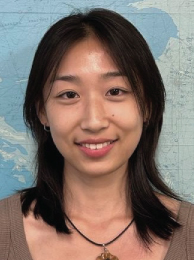
Qinlan Yang’s research focuses on understanding energetic teleconnections through atmospheric transport associated with the El Niño-Southern Oscillation (ENSO) using coupled GCMs. Specifically, she investigates the two-way coupling between surface temperature and Earth’s surface energy budget, as well as the large-scale energy redistribution within the Earth system during ENSO events. More broadly, her research interests encompass Earth’s energy budget, cloud-radiative feedback, climate sensitivity, and global warming, with the goal of better understanding climate variability and dynamics using observations and models. Qinlan is advised by Prof. Stephan Fueglistaler, a professor in the Department of Geosciences and the Program in Atmospheric and Oceanic Sciences.
-
Hirose, Lynn
Atmospheric and Oceanic Sciences
Hirose’s research is about the Earth’s energy budget, especially about the changes in outgoing longwave radiation (OLR). OLR is modified by the greenhouse gas effects and the Earth’s climate states, and the balance between the absorbed solar radiation and OLR determines the net gain or loss of energy of the entire climate system. She utilizes theoretical computations and diagnostic analysis of model simulations and satellite observations. She is advised by Prof. V. Ramaswamy in Geophysical Fluid Dynamics Laboratory.
-
Chung, Maya
Atmospheric and Oceanic Sciences
AY 24-25 PECS Student Dinner Coordinator
Chung studies the role of the ocean in climate from subseasonal to multi-century timescales. She also researches interactions between climate and infectious disease spread through the HMEI-STEP Fellowship. She is advised by professors Gabriel Vecchi (Geosciences, HMEI), Jessica Metcalf, and Bryan Grenfell (EEB, SPIA). -
Wang, Cindy (‘22 - ‘24)
Atmospheric and Oceanic Sciences
AY 23-24 PECS Project Coordinator
Wang’s research focuses on sea salt aerosols (SSA) because of the important role they play in the climate system through their effects on the global radiative budget. Wang’s research focuses on how SSA emissions themselves would change in the context of a warming climate. Wang is advised by Leo Donnor, lecturer in geosciences and atmospheric and oceanic Sciences.
-
Chua, Glen (‘21 - ‘23)
Atmospheric and Oceanic Sciences
AY 22-23 Project Coordinator
Chua aims to better understand the impacts of methane-emissions mitigation using chemistry-climate models. His research involves improving the representation of methane emissions in chemistry-climate models with the goal of improving our understanding of the climate, chemistry and air-quality impacts under different future emissions and climate change scenarios. Chua also is a 2021 HMEI-STEP Environmental Policy Fellow. He is advised by Larry Horowitz, lecturer in geosciences and atmospheric and oceanic sciences.
-
Yassin, Houssam (‘20 - ‘22)
Atmospheric and Oceanic Sciences
Yassin uses theoretical techniques to study the large-scale circulation of the atmosphere and ocean. At such large-scales, both the atmosphere and ocean are characterized by a fascinating combination of chaotic turbulence and coherent waves. Yassin is particularly interested in how the dynamics at the boundaries of these fluids (e.g. Earth’s surface) contributes to both the turbulent and wave-like motion in their interior.
-
Smyth, Jane (‘19 - ‘21)
Atmospheric and Oceanic Sciences
Smyth investigates the physical controls of tropical rainfall variability using climate models of varying complexity. Her research focuses on monsoons, large-scale systems that supply the majority of annual precipitation to land regions across the tropics. An improved mechanistic understanding of monsoon seasonality will enable better projections of how climate change may impact rainfall patterns. Smyth’s advisor is Yi Ming, Deputy Head of the Atmospheric Physics Division at the NOAA Geophysical Fluid Dynamics Laboratory.
-
Raghuraman, Shiv Priyam (‘18 - ‘20)
Atmospheric and Oceanic Sciences
Raghuraman, who is in the Program in Atmospheric and Oceanic Sciences, aims to understand the causes of energy imbalances in the atmosphere and how these imbalances impact the climate. His research focuses on the radiative forcing of the most important greenhouse gas — water vapor — which has a strong positive feedback on the climate system. He is advised by V. “Ram” Ramaswamy, director of the Geophysical Fluid Dynamics Laboratory and a Princeton lecturer with the rank of professor in geosciences and atmospheric and oceanic sciences.
-
Frazer, Michelle (‘17 - ‘19)
Atmospheric and Oceanic Sciences
Michelle Frazer is a Ph.D. student in the Program in Atmospheric and Oceanic Sciences, where she is advised by Dr. Yi Ming. Her work is focused on the role of clouds in the climate system, a chief source of uncertainty in climate modeling. She uses idealized and complex atmospheric general circulation models to isolate physical mechanisms connecting moisture distributions and clouds and improve understanding of cloud effects.
Michelle is also pursuing a certificate in Science, Technology, and Environmental Policy (STEP) as a STEP-PEI fellow. Her STEP project is considering the policy implications of regional climate responses to stratospheric aerosol albedo modification, a form of solar geoengineering.