



2025 Internship Project Overview
Our research focused on gaining a better understanding of how certain biominerals, specifically eggshells, record environmental signals and the information about the organism that produced them. There exist processes that overwrite the original geochemical signatures after deposition, making it difficult to distinguish primary signals from secondary modifications. To address this problem, we examined the rates of diffusion of elements and isotopes in these materials, with an emphasis on identifying eggshells suitable for uranium-thorium dating—a technique used to determine the age of material by analyzing the uranium and thorium concentrations.
We began our research by cataloging the eggshells and preparing our samples by cutting them with a wet saw, sanding them down, and then mounting them in epoxy to polish the surface and produce a smooth finish.
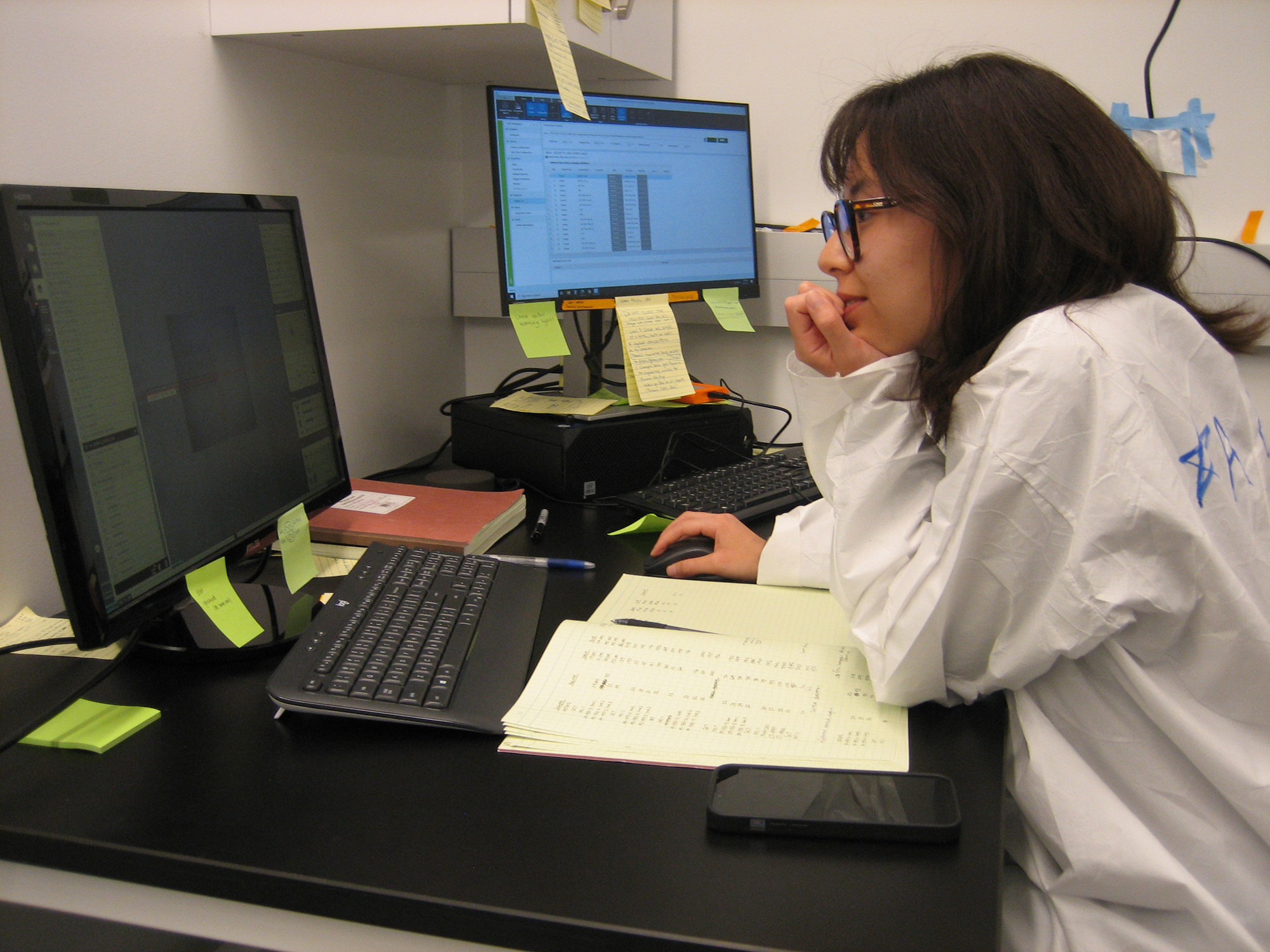
We then brought our samples into a clean lab, where we were able to use laser ablation inductively coupled plasma mass spectrometry (LA-ICP-MS) to measure trace element concentrations. We placed ablation lines onto our samples using iolite software and recorded elemental data that we later reduced to evaluate their uranium-thorium ratios.
This project enabled us to gain experience in sample preparation, clean lab techniques and the use of LA-ICP-MS in the context of our Earth’s geological archive.
ORGANIZATION/RESEARCH GROUP
Niespolo Research Group, Department of Geosciences, Princeton University
LOCATION
Princeton, New Jersey
Interns

Minor(s): Climate Science

Minor(s): Planets and Life
Click to view the end-of-project presentation
Principal Investigator

Mentors
- Alliya Akhtar, Postdoctoral Research Associate, Geosciences
- Noe-Heon Kim, Ph.D. Candidate, Geosciences