



2025 Internship Project Overview
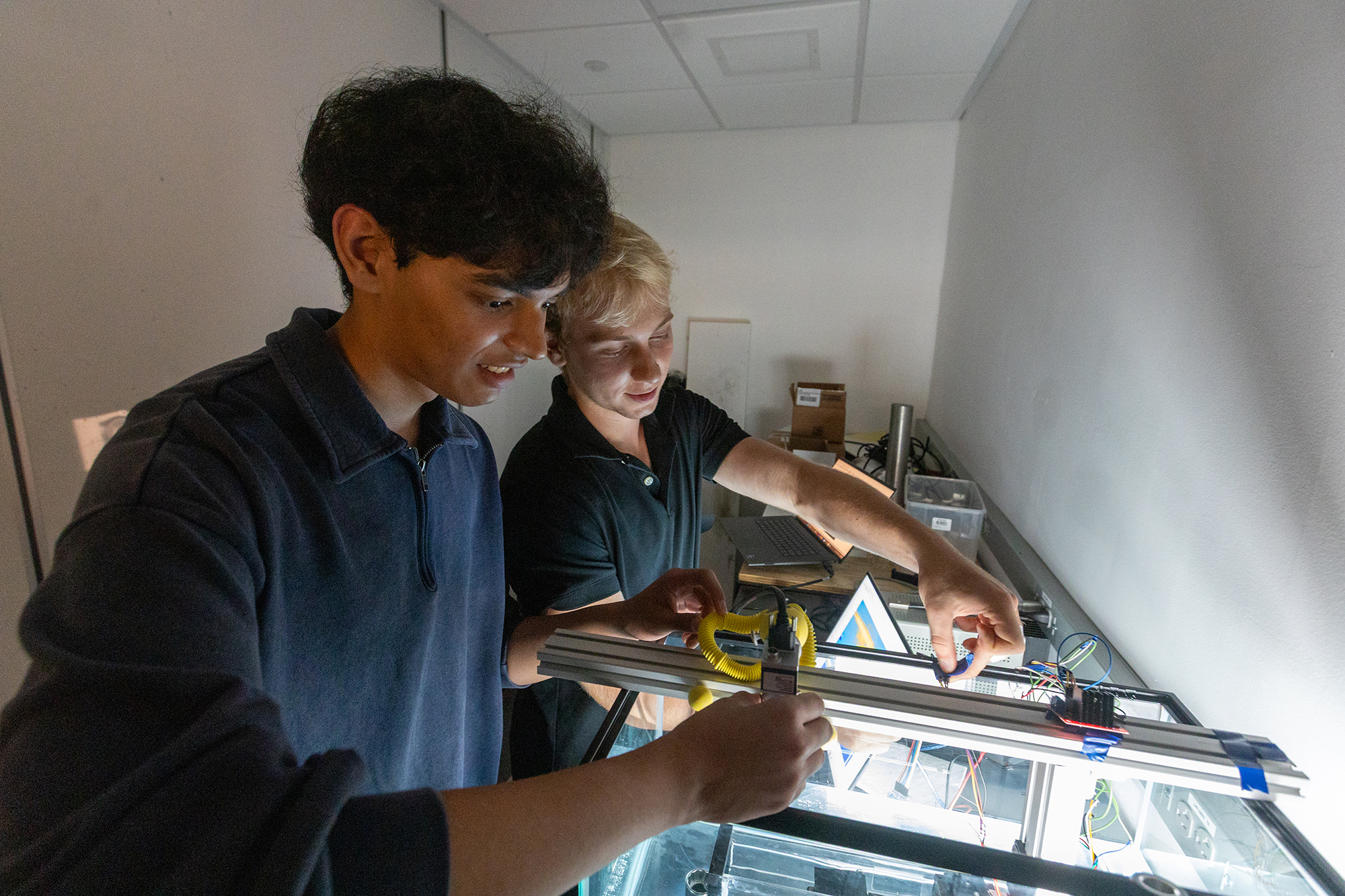
Microplastics are a significant source of pollution in our water sources and conventional methods for collecting microplastics are often inefficient. Our research project focused on exploring the efficiency of a floating robotic collector, known as an undulator, designed to remove microplastics from the water’s surface. The undulator utilizes interfacial pumping to reduce the bulk flow. In our experiments, we attempted to characterize the flow around the undulator, using tracer particles ranging from 100 micrometers to 1180 micrometers, which were recorded by a Basler scientific camera. Through experimentation, it was found that local maxima for surface velocity of particles occur at specific frequencies and water heights. It was also found that different particles flow at different velocities, suggesting that the particles do not exhibit tracer-like behavior in the flow. In the future, we hope to gain a deeper understanding of why these effects occur.
ORGANIZATION/RESEARCH GROUP
DiBenedetto Fluids Lab, Department of Mechanical and Aerospace Engineering, Princeton University
LOCATION
Princeton, New Jersey
Interns


Minor(s): Computer Science
Click to view the end-of-project presentation
Principal Investigator
