



2025 Internship Project Overview
As part of the European Space Agency’s “Medicanes” Project, we developed machine learning (ML) pipelines that use satellite measurements to improve the understanding and prediction of medicanes. Medicanes are tropical-like cyclones in the Mediterranean Sea region characterized by a deep warm core (warm anomaly extending from the middle to upper troposphere at the storm center) and a nearly closed rotation of the wind field.
We curated a dataset (correcting sensor inconsistencies), surveyed state-of-the-art ML approaches and delivered models for this novel satellite-based detection task.
To automatically detect warm cores, we implemented a semi-supervised anomaly detection method that utilizes an autoencoder’s reconstruction error (the difference between observed and reconstructed data) and evaluated it on data from 800+ cyclones.
To detect the nearly closed rotating wind field, we preprocessed wind data from Advanced Scatterometer (ASCAT) on board the European MetOp satellites. We trained a U-Net semantic segmentation model (which assigns a label to each point) with partial convolution layers to handle missing data over land.
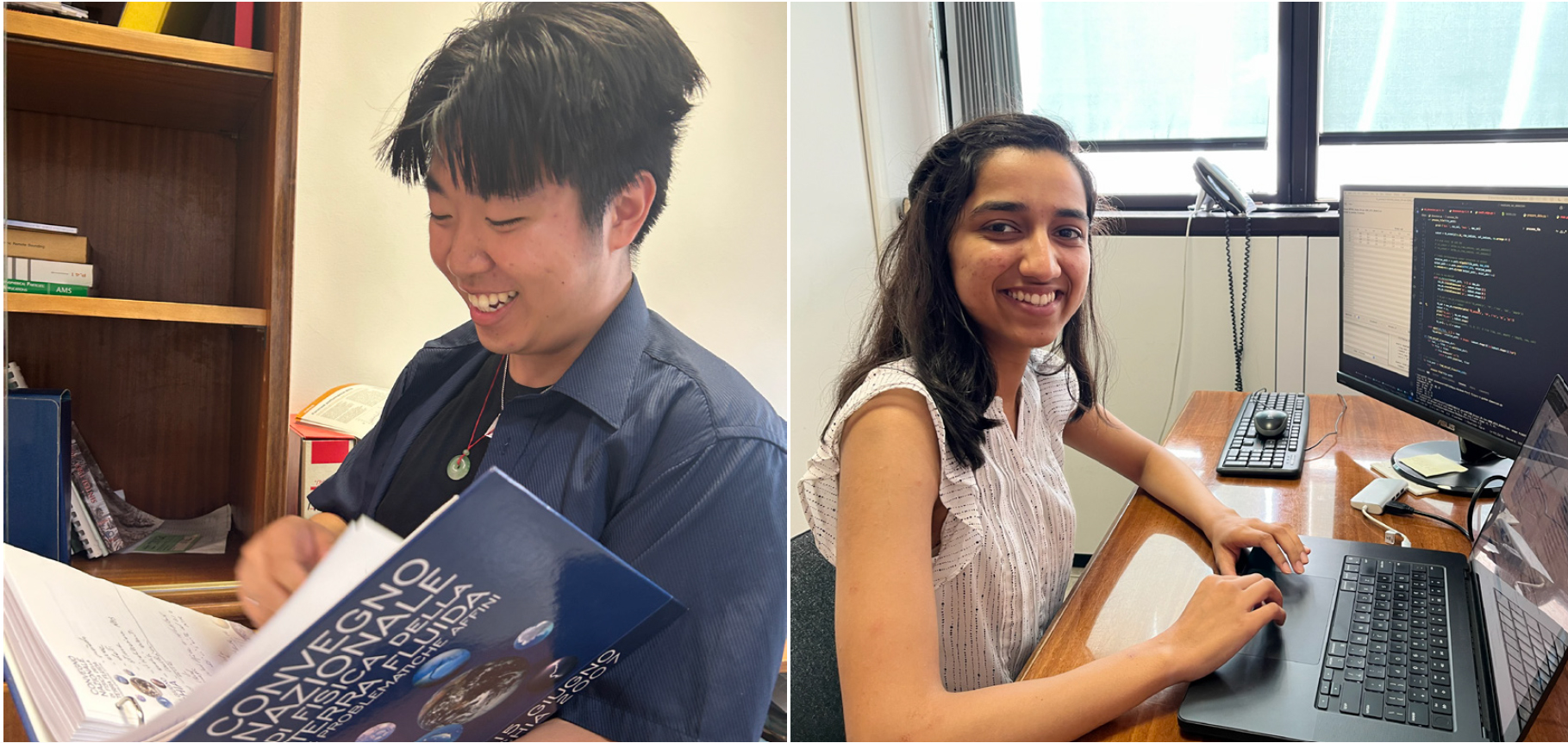
ORGANIZATION/RESEARCH GROUP
National Research Council of Italy, Institute of Atmospheric Sciences and Climate (CNR-ISAC)
LOCATION
Rome, Italy
Interns

Minor(s): Mathematics

Minor(s): Statistics and Machine Learning, Sustainable Energy
Click to view the end-of-project presentation
Principal Investigator

Mentors
- Leo Pio D’Adderio, Postdoctoral Research Associate, CNR-ISAC
- Giulia Panegrossi, Senior Research Scientist, CNR-ISAC
- Stefano Sebastianelli, IT Remote Sensing, CNR-ISAC