



2025 Internship Project Overview
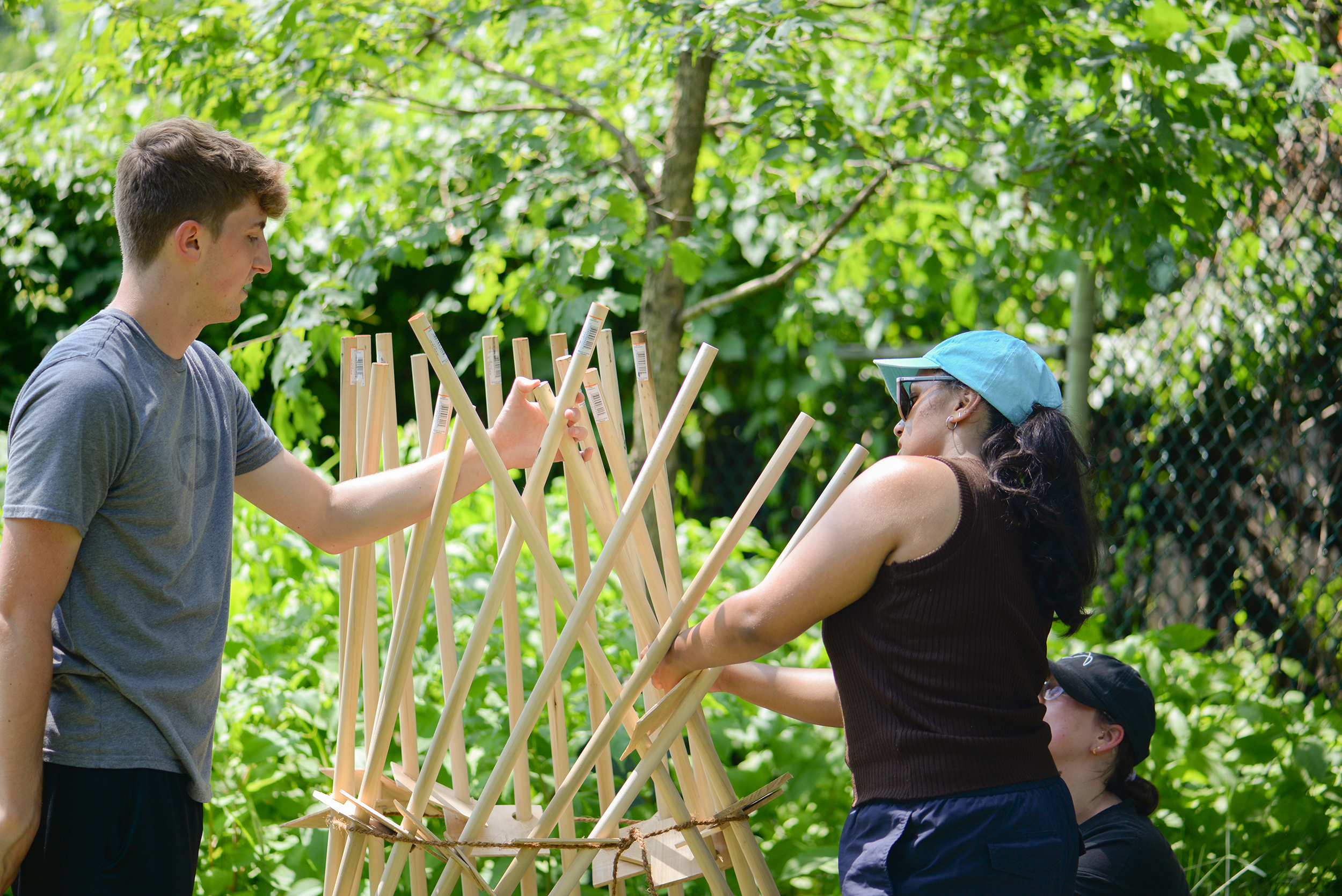
This project explored wood’s self-bending properties in order to design and construct a fully biodegradable habitat to support insect biodiversity in Princeton’s student garden. Using the concept of animal-informed infrastructure, the design mimics the ecological role of veteran trees, whose decay is crucial in promoting biodiversity. The team combined ecological research with material testing, studying insect habitat preferences and analyzing both natural and man-made structures. Experiments on different raw greenwood species examined how moisture content, grain orientation and material dimensions influence deformation and decay. These findings were then used to inform a design logic that integrated these natural behaviors into a structure that supports both ecological and human interaction. The final prototype—a curved, foldable, sheet-like form—creates habitat niches while offering space for observation. Locally sourced greenwood from a small lumber mill supported a sustainable, circular approach. This model prototypes a replicable methodology for biodiverse, sustainable urban planning where human and non-human species coexist.
This internship is connected to the HMEI Biodiversity Grand Challenges project, “Building for Biodiversity: Animal-informed Planning and Design.”
ORGANIZATION/RESEARCH GROUP
Form Finding Lab, Department of Civil and Environmental Engineering, Princeton University
LOCATION
Princeton, New Jersey
Interns

Minor(s): Architecture and Engineering, Urban Studies

Minor(s): Environmental Studies, Urban Studies
Click to view the end-of-project presentation
Principal Investigator

Mentors
- Amir Mahdiyar, Associate Research Scholar, Civil and Environmental Engineering
- Ruta Stankeviciute, Postdoctoral Research Associate, Civil and Environmental Engineering