



2025 Internship Project Overview
Ordinary Portland Cement (OPC) is a widely used construction material, but manufacturing its main component, clinker, emits significant CO2. To address this, we studied two cement systems that reduce clinker usage with calcined clays, which are heated at 650–850°C to increase reactivity.
In alkali-activated calcined clay cements (AAC), calcined clay fully replaces clinker and reacts with an alkaline activator solution to produce an amorphous aluminosilicate gel, contributing to high stress tolerance. In limestone calcined clay cements (LC3), calcined clay and limestone partially substitute clinker, reacting to create hydration products that provide durability and strength.
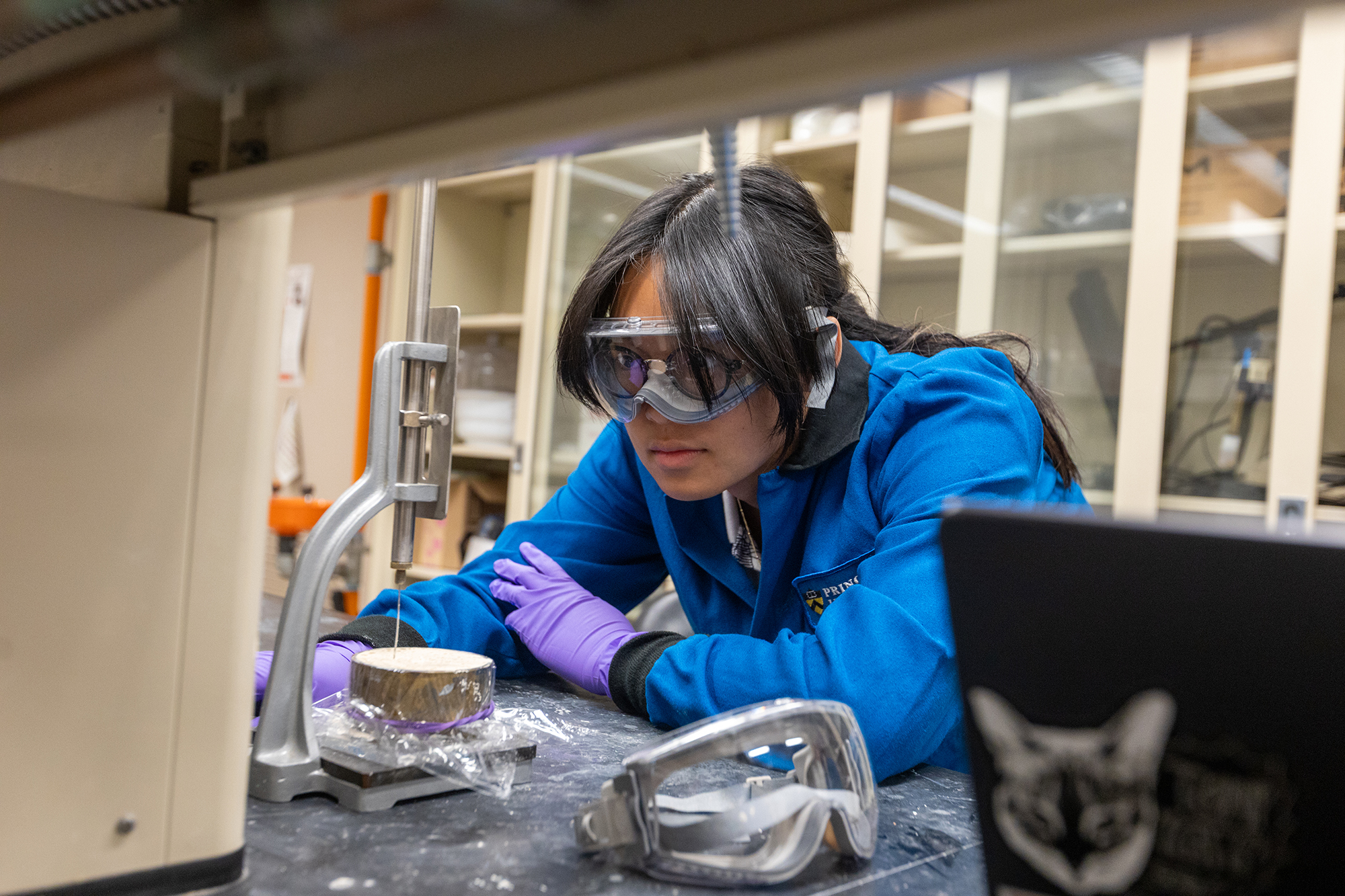
As calcined clays vary in structure and reactivity, we explored mix designs for each system with six calcined clays, observing reactivity with isothermal calorimetry and strength development via compressive strength testing. We also conducted a material carbon assessment using information from the literature. Overall, there were comparable compressive strength results between systems while demonstrating emissions reductions, with one AAC design producing ~47% less carbon emissions than OPC.
ORGANIZATION/RESEARCH GROUP
Sustainable Cements Group, Department of Civil and Environmental Engineering, Princeton University
LOCATION
Princeton, New Jersey
Interns

Minor(s): Gender and Sexuality Studies

Minor(s): Materials Science and Engineering, Sustainable Energy
Click to view the end-of-project presentation
Principal Investigator

Mentors
- Abdelrahman Hamdan, Postdoctoral Research Associate, Andlinger Center for Energy and the Environment