




Rapid Evolution to Climate in a Community of California Annual Plants
Levine Lab
University of California Sedgwick Reserve, Santa Barbara County, California; Princeton University, Princeton, New Jersey.
Biodiversity and Conservation
Fieldwork, Labwork
January 7, 2026 2:00 pm EST
Internship / Research Project Information
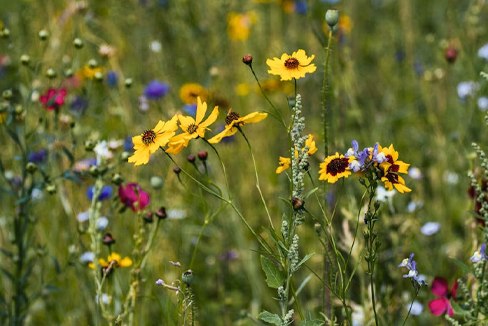
Annual wildflowers in California occur in remarkably diverse communities. Each year, these communities face drastically different environmental conditions, including the timing and amount of rainfall. The goal of this project is to measure how different rainfall conditions and competitive environments might cause natural selection on yearly timescales. In principle, these evolutionary changes could help explain how diverse communities coexist and how they might respond to climate change. Yet, while rapid evolution has been described in several species, its effects on entire communities and their ecological dynamics are poorly understood. Therefore, we are setting up a field experiment to manipulate rainfall and competition for different populations of annual plants. For each population, we are going to track their population growth (how many seeds they produce) as well as the genetic changes that occur due to these different treatments.
Students will have the opportunity to apply diverse methods ranging from fieldwork to labwork and consider concepts from community ecology and genomics. The first portion of the internship will be at the UC Santa Barbara’s Sedgwick Reserve, which is located adjacent to the Los Padres National Forest on the Central Coast of California. The student will work in the field to 1) collect seeds produced by the experimental populations for sequencing, and 2) take measurements of focal plants/flowers. The student may also have the opportunity to do some drylab work to measure common plant traits such as specific leaf area (SLA), aboveground biomass, etc. Students may also engage with the surrounding natural landscape to collect seeds or field data.
The second portion of the internship will be on Princeton’s campus where the student will help process samples. This may include a wet lab component where students will sequence plants collected from the experiment to analyze how the experimental conditions drive evolution. If there is sufficient time and interest, the student may have the opportunity to help analyze ecological and/or genomic data using tools such as R.
Students will:
- Learn experimental design in plant community ecology
- Become familiar with eco-evolutionary processes and drought experiments
- Learn methods to process plant materials, take measurements of plant functional traits in the field
- Become familiar with methods to extract DNA from plant tissue and modern methods in genomics
Faculty Sponsor(s) / Host Information
Jonathan Levine
Ecology and Evolutionary Biology (EEB)
Internship Requirements
None required! We’ll teach you everything you need to know, but some introductory laboratory experience (e.g. through MOL 214) would be helpful. EEB classes also recommended.
Attention to detail, willingness to work independently and occasionally complete repetitive tasks.
Some hiking in hot, dry weather across uneven terrain.
Some outdoor gear is recommended, including hiking boots and a sun hat. If you have any concerns about access to outdoor gear, please feel free to reach out to supervisors Zach Gold (zgold@princeton.edu) or Diego Perez (diegoraf@princeton.edu).
- This internship will take place at both Sedgwick Reserve and Princeton University. While at the Reserve, the student should be comfortable working in close proximity with the small research team for long periods of time, including communal cooking and eating.
- Selected students are required to meet with internship mentors prior to the internship start date. Reading materials may also be provided.
- Selected students are required to register their travel with the University through Enroll My Trip. Information related to the University’s Permissible Travel Guidelines can be found here. Funding is contingent on travel registration and University approval.
- Students are responsible for securing accommodations for the duration. Please note that on-campus summer housing is typically available the first week of June until the first week of August (details to become available in Spring 2026). If the internship falls outside of on-campus housing availability, students will need to secure alternate housing.
Internship / Project Supervisor(s)
Zach Gold, PhD Candidate, EEB
Diego Perez, PhD Candidate, EEB
Internship Dates And Funding Information
2
8
June 1, 2026 to July 25, 2026