




Multi-predator Effects on Large Mammalian Herbivore Behavior in KwaZulu-Natal, South Africa
Pringle Lab
KwaZulu-Natal, South Africa (Hluhluwe-iMfolozi Park, Thanda Game Reserve, and Pongola Game Reserve)
Biodiversity and Conservation
Fieldwork
January 7, 2026 2:00 pm EST
Internship / Research Project Information
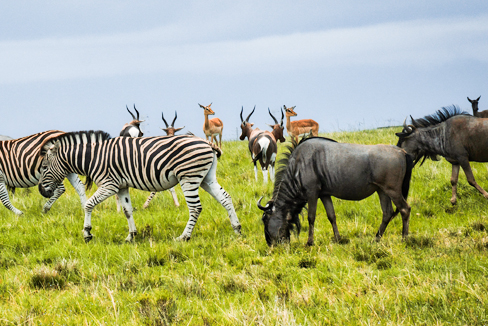
As ecosystems face accelerating biodiversity loss globally, a fundamental ecological question persists: what factors maintain species diversity? Predation has long been considered a key ecological process in diversity maintenance, facilitating coexistence among prey species by depleting dominant competitors, thus relaxing interspecific competition. However, recent theoretical and empirical evidence suggests that the relationship between predation and interspecific competition is much more complex; predation can instead undermine prey coexistence depending on factors such as prey mobility and refuge availability, among others. Still, empirical tests of these dynamics– particularly in natural systems comprising a multitude of interacting predator and prey species– remain scarce. This project aims to investigate the role of predation in shaping interspecific competition among large mammalian herbivores, integrating indirect fear effects on prey behavior and multi-predator effects. Accordingly, we will use GPS movement data, collect scat samples to analyze diet composition via DNA metabarcoding, and observe predator-avoidance behaviors of large mammalian herbivores across three closely-situated reserves in KwaZulu-Natal, South Africa that vary in their apex carnivore community composition (Hluhluwe-iMfolozi Park, Thanda Game Reserve, and Pongola Game Reserve).
Interns will gain experience collecting several kinds of data using a variety of field methods. Interns will help set up camera traps to record herbivore behavioral responses to playback experiments, identify and collect scat samples from various carnivore and herbivore species, directly observe and record herbivore behaviors and group sizes, record instances of predation, learn relevant plant IDs, organize and classify video data, and set up a resource-enrichment field experiment. Interns are also highly encouraged to be active participants in developing fieldwork protocols and field experiments. This project is very collaborative, so interns will also have the opportunity to work with and meet various park ecologists, wildlife management teams, conservation organizations, and researchers from other institutions. Interns should be highly motivated to work long days outdoors, be enthusiastic team members, and be eager to visit and collect data from multiple game reserves.
By the end of the summer, students will have learned many common observational field methods, such as camera trapping, scat collection, and behavioral observations, and experimental methods, like playback experiments. Students will also learn about the logistics of designing and implementing independent field research. Students will know how to curate large datasets and process, classify, and analyze camera trap video data. Importantly, students will have developed their understanding of the natural world and particularly the ecology and natural history of South African ecosystems. Students will leave the field with more knowledge on two fundamental ecological processes: competition and predation.
Faculty Sponsor(s) / Host Information
Rob Pringle
Ecology and Evolutionary Biology (EEB)
Internship Requirements
No academic background or prerequisites are required, but ideally students will have taken EEB 321 or demonstrate a scientific interest in community ecology and conservation. Students will have the opportunity to learn relevant scientific background by reading scientific literature prior to the field season. Students from any year are encouraged to apply. Students earlier on in their degree will also have the opportunity to potentially expand their work into a senior thesis if they're interested.
Interns will be trained in the field to collect data and use equipment, so no prior skills are necessary. Prior fieldwork experience is also not required, although any outdoors experience would be beneficial. Students should be detail-oriented and organized, and feel comfortable working long hours outside.
Health and Safety for Animal Workers (IAUCUC); Wilderness First Aid training (if available to take in the spring) is recommended but not necessary
Students will be expected to wake up early (~6am) and work for up to 8 hours a day. Temperatures fluctuate from fairly cold in the morning to hot in the afternoon. Students will work in savannas with areas of very little shade, so students will need to protect their skin and eyes while out in the sun. Fieldwork will require hiking most days, and the field sites are particularly hilly and so hikes may be strenuous. Students will also need to carry equipment like camera traps, as well as sufficient food and water for the field day. Dirt roads in some field sites can be in poor condition, so the drives can be very bumpy (students will not be drivers, just passengers).
Zulu is the most common language spoken in KwaZulu-Natal, South Africa. Park staff and other researchers speak English, so knowledge of Zulu isn't necessary but is an asset.
Students should bring field-appropriate gear and clothes (long pants/ long sleeves in natural colors like tan, brown, or green, binoculars, backpack, hiking boots, water bottles, hats). It will be winter in South Africa during the field season, and it can get fairly cold, so coat/hat/sweatshirts are also important. Students should also bring their own laptops. A full packing list will be provided to students in advance of the internship start.
- Students will meet with internship mentors in the spring, prior to the internship start date. Reading materials may also be provided.
- Student(s) are responsible for securing accommodations for the duration of the internship.
- Students are also required to familiarize themselves with the data collection protocols and platforms (e.g., ArcGIS Field Maps) prior to fieldwork.
- Students will need to consult UHS for travel medical requirements. It is the responsibility of the student to be aware of entry requirements and to obtain any necessary documentation. Valid passport required. Students are required to register their travel with the University through Enroll My Trip. Information related to the University’s Permissible Travel Guidelines can be found here. Funding is contingent on travel registration and University approval.
- U.S. citizens do not need a visa to enter South Africa if they are staying for less than 90 days, but students from other countries should confirm any visa or entry requirements.
International Travel Requirements
No
Yes
Yes
Internship / Project Supervisor(s)
Rory Wakeford, Ph.D Candidate, EEB
Internship Dates And Funding Information
$800 (plus int’l travel award)
1-2
9
June 1, 2026 to August 3, 2026