




Movement Ecology and Disease Dynamics of Translocated Eastern Box Turtles
Duke Farms
Hillsborough, NJ
Biodiversity and Conservation
Fieldwork
January 7, 2026 2:00 pm EST
Internship / Research Project Information
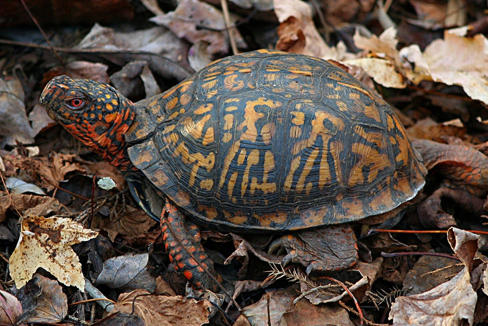
The Ecology and Nature Tech Solutions team at Duke Farms is studying the movement, health, and survival of translocated eastern box turtles to better understand the ecological and physiological challenges associated with translocation as a conservation tool. Translocation is increasingly used to restore or augment wildlife populations, yet its outcomes can vary depending on how animals adjust to unfamiliar environments. This project will use GPS tracking and health assessments to compare resident and translocated box turtles within a quasi-experimental design. The study will evaluate differences in movement patterns, space use, and resource tracking, and will investigate how disease status may influence these behaviors or be transmitted through contact between individuals. By combining spatial ecology with wildlife health monitoring, this work will provide new insights into how translocation affects turtle behavior, disease dynamics, and long-term population viability in fragmented landscapes.
The student will assist researchers with fieldwork and data collection for an ongoing study of eastern box turtles at Duke Farms. Responsibilities will include locating, capturing, and processing turtles in the field, assisting with GPS tag deployment, and collecting morphometric, health, and diet samples. The student will track tagged individuals regularly to record location data and behavioral observations, contributing to assessments of movement patterns and habitat use. In addition to field activities, the student will help manage and organize spatial and biological data, ensuring data accuracy and consistency throughout the study period.
By participating in this internship, the student will gain hands-on experience in wildlife research, focusing on the ecology, health, and behavior of eastern box turtles. They will learn standard field techniques for capturing, handling, and tagging turtles, as well as methods for collecting biological and environmental data to assess animal condition, diet, and movement. The student will also learn to download, manage, and interpret GPS tracking data to quantify movement patterns and habitat use. Through this experience, the student will develop a broader understanding of how translocation influences wildlife behavior, survival, and disease dynamics. They will also gain exposure to the principles of experimental design in animal movement studies and learn how spatial data can be used to address ecological and conservation questions.
Faculty Sponsor(s) / Host Information
Mitchell Serota
Ecology
Internship Requirements
Attention to detail, enthusiasm for field-based ecological research, ability to work long hours outdoors in hot and humid conditions, ability to work both independently and as part of a team, interest in learning data management tools
Field work can be strenuous in hot and humid conditions
- Students should bring a laptop, as well as clothing appropriate for fieldwork, including long pants, sturdy boots, hats, and other gear suitable for working outdoors in hot and humid conditions.
- Duke Farms is 15 miles from Princeton University and is difficult to access without a vehicle.
- Students will meet with internship mentors in the spring, prior to the internship start date. Reading materials may also be provided.
- At the start of the internship, all interns will participate in an 8-hour orientation and training specific to Duke Farms. This training will include getting to know each other and staff, an introduction to the site and its protocols, field safety procedures, and hands-on instruction in technical sampling. Emphasis will be placed on proper data collection, management, and best practices to ensure high-quality, accurate data that support ongoing research and conservation efforts.
- Students are responsible for securing accommodations for the duration of their internship. On-campus summer housing is typically available the first week of June until the first week of August (details to become available in Spring 2026). If the internship falls outside of on-campus housing availability, students will need to secure alternate housing.
Internship / Project Supervisor(s)
Mitchell Serota, Scientist and Manager of Ecology, Duke Farms
Erin Treanore, Scientist and Manager of Agroecology, Duke Farms
Internship Dates And Funding Information
$800
2
8
June 1, 2026 to July 24, 2026