




Investigating Hummingbird Behavior, Wildflower Interactions and Climate Change in the Rocky Mountains
Stoddard Lab
Rocky Mountain Biological Laboratory in Gothic, Colorado; Surrounding areas in Gunnison County, Colorado
Climate and Environmental Science
Fieldwork
January 7, 2026 2:00 pm EST
Internship / Research Project Information
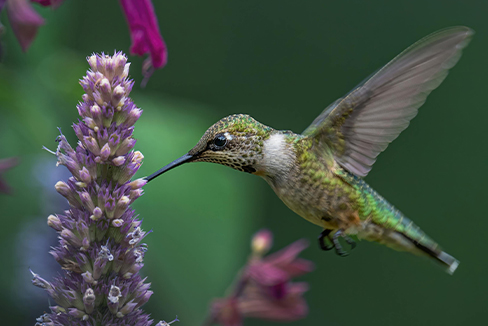
We study wild Broad-tailed Hummingbirds at the Rocky Mountain Biological Laboratory in Gothic, Colorado. These migratory hummingbirds are critical pollinators of wildflowers at this high-elevation montane site (2,900 m). Changes in the timing of snowmelt (attributed to climate change) in recent years have contributed to shifts in the timing of floral bloom. Changes in flower phenology are likely to impact pollinators: the arrival of hummingbirds at their breeding site in the Rockies might be mismatched with floral bloom. Our goal is to obtain a clearer picture of hummingbird pollination behavior. Which flowers do hummingbirds visit, and how does this change throughout the summer, as different species of wildflower become available? We will use camera traps to quantify the diversity of flowers and the frequency of visitation. We will also use a hyperspectral camera to obtain a “bird’s eye-view” of the habitats frequented by hummingbirds. This project has a substantial computational/data analysis component. Students will learn to process and analyze video/image data and will become familiar with computer vision techniques.
We seek highly motivated, independent students who are eager to work in a rustic but stunning mountain field environment. Responsibilities will also include assisting with ongoing Stoddard Lab research projects at the Rocky Mountain Biological Laboratory. We are particularly looking for students interested in natural history and excited to study ecology using new technology ( cameras, software, computer programming). Our work is highly collaborative. Students should be enthusiastic about working with a team on multiple projects. Students should also be eager to learn how to analyze, process and organize imaging/video data.
At the end of the summer, students should have a rich understanding of the ecology and natural history of hummingbirds in the Rocky Mountains. Students should have gained experience planning experiments, collecting and analyzing video/image data, observing wild animals, and working with a team. Students will also have had the opportunity to improve coding skills (R, Matlab).
Faculty Sponsor(s) / Host Information
Mary C. Stoddard
Ecology and Evolutionary Biology (EEB)
Internship Requirements
We seek risking sophomores and juniors (and, in rare occasions, seniors) with a strong interest in ecology, evolution and the environment. Coursework in ecology and/or evolution preferred. Computer science and/or statistics background welcome but not required. Technical skills: We seek students with a strong interest in the outdoors and in field-based research. Excellent organizational skills are required. Interest in animal behavior, birds, flowers and natural history preferred, as well as an interest in using technology (including cameras, software and programming).
Health and Safety for Animal Workers (IACUC)
Students should be comfortable working actively outdoors every day for ~8 hrs/day. A moderate amount of hiking is involved. Our research requires patience and attention to detail, particularly with respect to identifying and counting flowers.
Work is conducted in a high-altitude field environment in Colorado, where awareness of animal- borne illnesses (such as those carried by ticks and mice), mountain wildlife, and hiking safety is necessary.
Students must bring a laptop.
- Students will meet with internship mentors in the spring, prior to the internship start date. Reading materials may also be provided. On-site lab and safety training will be provided at RMBL at the start of the internship.
- Selected student(s) will need to complete RMBL registration upon acceptance. Student(s) are responsible for station fees and are encouraged to select housing at RMBL that fits within budget.
- Students are required to register their travel with the University through Enroll My Trip. Information related to the University’s Permissible Travel Guidelines can be found here. Funding is contingent on travel registration and University approval.
- In addition to Prof. Stoddard, students will be supervised by Stoddard Lab members: Ben Hogan (Postdoc), Sarah Solie (Postdoc), Katja Kochvar (PhD student). When members of the Stoddard Lab are not at RMBL, students can contact Dr. Jennie Reithel, Scientific Director of RMBL (jennifer@rmbl.org).
Internship / Project Supervisor(s)
Jennie Reithel, Scientific Director of RMBL
Internship Dates And Funding Information
$800 (plus travel award)
3
9
June 8, 2026 to August 7, 2026