




Host Switching by an Introduced Brood Parasitic Bird in California
Riehl Lab, Princeton University
Southern California
Biodiversity and Conservation
Fieldwork
January 7, 2026 2:00 pm EST
Internship / Research Project Information
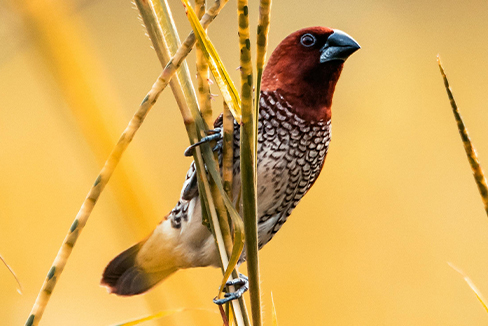
Introduced species are everywhere. Human activity in the current century has transported organisms thousands of miles away from their native ranges, resulting in the establishment of thousands of introduced species in the U.S. alone. Introduced species often interact with the native environment in harmful ways, reducing biodiversity. What happens when two introduced species from different home ranges interact competitively with each other? The Pin-tailed Whydah (Vidua macroura), native to Africa, is an obligate brood parasite: it lays its eggs in nests of other bird species and relies on them to care for its eggs and young. Whydahs have been introduced to Southern California, where they parasitize Scaly-breasted Munias (Lonchura punctulata), a South Asian species similarly introduced via the pet trade. The whydah appears to be “winning,” over the munia, parasitizing munia nests freely and predating their eggs. However, munias have begun to exhibit protective defense behaviors, such as aggression towards whydahs. The aim of this project is to further explore the interactions between parasitic whydahs and parasitized munias in Southern California, examining how munias and whydahs modify their behavior in response to the novel relationship. The project will also explore the possibility that whydahs could become an invasive species, parasitizing native California birds. We will use multiple techniques, including bird banding, nest cameras, blood sampling for genetic analysis, and observational surveys, to address these questions.
The student intern will assist with field work at three study sites in southern California, including locating and monitoring Scaly-breasted Munia nests, deploying nest cameras, conducting in-person behavioral observations, and recording data on nest success as well as behavioral interactions between munias and whydahs. The intern will be trained by, and work closely with, Elisa Yang, a Ph.D. student in the Ecology and Evolutionary Biology Department, and other field assistants. Field work will typically start early in the morning and will involve long hours outside watching birds and locating nests. No prior experience is required, but enthusiasm, interest, and the ability to enjoy the outdoors are all crucial!
After participating in this internship, the student will have a thorough practical knowledge of field techniques in behavioral ecology (including the use of behavioral observations, genetic sampling, and field experiments), an understanding of the evolutionary dynamics between brood parasitic birds and their hosts (including coevolutionary arms races and behavioral adaptations), and hands-on experience in gathering, collating, and analyzing data to test adaptive hypotheses. Interns will also learn how to work as part of a field team and how to collaborate on a research project to accomplish shared goals.
Faculty Sponsor(s) / Host Information
Christina Riehl
Ecology and Evolutionary Biology (EEB)
Internship Requirements
There are no academic prerequisites, but an interest in field biology and animal behavior is key!
Interns should be prepared for early mornings and outdoor field work (which occasionally involves heat, bugs, long hours, and other joys of the great outdoors).
Health and Safety for Animal Workers (IACUC)
Field sites are in suburban southern California, which is generally pleasant and dry, but interns should be prepared for sun and some walking. Interns should be reasonably physically fit (they may occasionally need to help carry ladders, cameras, and other equipment) but no strenuous lifting or hiking is anticipated.
We will provide binoculars if the intern does not already have them.
- This is an exciting opportunity to study the early stages of a novel host-parasite interaction in wild birds, closely mentored by a graduate student at beautiful field sites in California.
- Students will meet with internship mentors in the spring, prior to the internship start date. Reading materials may also be provided.
- Student(s) are responsible for securing accommodations for the duration of the internship.
- Students are required to register their travel with the University through Enroll My Trip. Information related to the University’s Permissible Travel Guidelines can be found here. Funding is contingent on travel registration and University approval.
Internship / Project Supervisor(s)
Elisa Yang, Ph.D. Candidate, EEB
Christina Riehl, EEB
Internship Dates And Funding Information
$800
1
8
June 1, 2026 to July 24, 2026