




Computational Biology to Support Lion and Zebra Conservation
Rubenstein Lab, Princeton University
Mpala Research Centre, Kenya
Biodiversity and Conservation
Computational Modeling/Data Analysis, Fieldwork
January 7, 2026 2:00 pm EST
Internship / Research Project Information
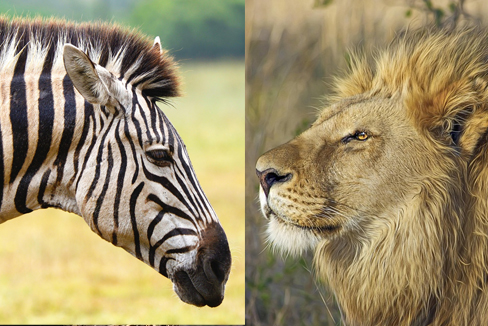
This project investigates how wild lions and zebra herds coordinate their movements during hunts and escapes, combining ecological fieldwork with cutting-edge drone and computer vision technologies. Beyond revealing the mechanics of predator–prey interactions, the work aims to support lion conservation and coexistence strategies by improving our understanding of how hunting behavior adapts to environmental change and human pressures.
We will address three central ecological questions:
- Do wild lions follow the same geometric pursuit strategies observed in controlled captive settings, or do natural conditions produce more adaptive and flexible hunting tactics?
- Do lions coordinate as a team—exhibiting spatial organization or role specialization—or do they function as independent agents during group hunts?
- How do zebra herds adjust their collective escape strategies across diurnal and nocturnal periods, and what environmental factors drive these differences?
To investigate these questions, we will simulate prey movement using an edible lure suspended from a racing drone, allowing for non-invasive, safe elicitation of natural hunting behavior. Dual synchronized UAVs will record lion chases, providing high-resolution spatial and kinematic data. These recordings will be compared with a controlled dataset collected from ten captive lions at Lion Country Safari (Florida), where mechanized lures were used to model prey dynamics under repeatable conditions.
Additionally, over forty high-resolution UAV videos of zebra escape responses collected during Princeton’s “Visualizing Nature” field course will be analyzed alongside new low-light UAV footage. This will enable the first systematic comparison of diurnal and nocturnal escape coordination under natural predation pressure.
Together, these datasets will deepen our ecological understanding of how lions hunt and how prey respond, providing valuable insights into energy expenditure, group coordination, and behavioral adaptability. Such knowledge is crucial for lion conservation management, particularly in fragmented landscapes where altered prey behavior and human–wildlife conflict are changing the ecological balance. By linking behavioral ecology with conservation technology, this project aims to advance both the science and the stewardship of one of the world’s most iconic predators.
The students will play an active role in both field data collection and post-processing at the Mpala research base. In the field, they will assist in planning and coordinating the drone flight schedule, monitor lion GPS movements in real time, and help operate UAVs during data collection sessions. They will gain hands-on experience in the practical aspects of aerial wildlife monitoring, including managing battery logistics, flight safety, and optimal camera positioning for behavioral recording.
Back in the classroom at Mpala the students will help organize and archive video data, edit footage using Adobe Premiere Pro, and contribute to data curation for subsequent analysis. They will be trained to extract and process animal movement trajectories using pose-estimation software for behavioral analysis. Through these tasks, the student will develop a comprehensive understanding of both the technological and analytical components of modern animal behavior research, from field acquisition to quantitative analysis.
This internship will provide the student with comprehensive training in both ecological fieldwork and computational behavioral analysis. The student will gain hands-on experience conducting field studies of large carnivores and ungulates, including planning UAV flight paths, monitoring lion GPS movements, and recording animal behavior safely and ethically in natural settings. They will learn how to work effectively in dynamic field environments, collect standardized ecological observations, and manage data under real-world conditions.
In parallel, the student will build technical competencies in data organization, video editing (Adobe Premiere Pro), and movement analysis using SLEAP, an AI-based tool for extracting animal trajectories from video. By integrating these methods, they will develop an understanding of how animal movement data can be used to address ecological and behavioral questions about predation, coordination, and environmental response.
Overall, the internship will train the student to bridge field ecology and computational analysis, preparing them to contribute to cutting-edge research in movement ecology, conservation technology, and animal behavior.
Faculty Sponsor(s) / Host Information
Daniel Rubenstein
Ecology and Evolutionary Biology (EEB)
Internship Requirements
Students should be computationally inclined, with an openness to learning analytical tools for video processing, data management, and movement analysis.
This project is best suited for practically minded students who are comfortable working in dynamic field environments and have an interest in animal behavior and ecology. Students should be prepared for outdoor fieldwork, sometimes in warm or variable weather conditions, and demonstrate an ability to work carefully and safely around wildlife and equipment. Basic familiarity with GIS, remote sensing, or flying drones is helpful but not essential, as full training will be provided.
The student needs to have average physical fitness as this is a fieldwork based internship in various outdoor weather conditions
We shall provide all equipment related to the research, but the student will need clothing and footwear appropriate for being outside in Kenya during various temperatures and conditions. Sunscreen is required, high ankle hiking shoes and a laptop.
- Students will meet with internship mentors in the spring, prior to the internship start date. Reading materials may also be provided.
- The cost of international travel and room and board at the Mpala facility will be covered by HMEI. In addition, the selected student will receive a stipend for the summer to defray incidental costs.
- Students will need to consult UHS for travel medical requirements.
- It is the responsibility of the student to be aware of entry requirements and to obtain necessary documentation, including visas and research permits as applicable. Valid passport required.
- Students are required to register their travel with the University through Enroll My Trip. Information related to the University’s Permissible Travel Guidelines can be found here. Funding is contingent on travel registration and University approval.
International Travel Requirements
Yes
Yes
Yes
Internship / Project Supervisor(s)
Daniel Rubenstein, EEB
Isla Duporge, Postdoctoral Research Associate, EEB
Internship Dates And Funding Information
$100
2
8
June 1, 2026 to July 31, 2026