




Chaz Bethel-Brescia ’22
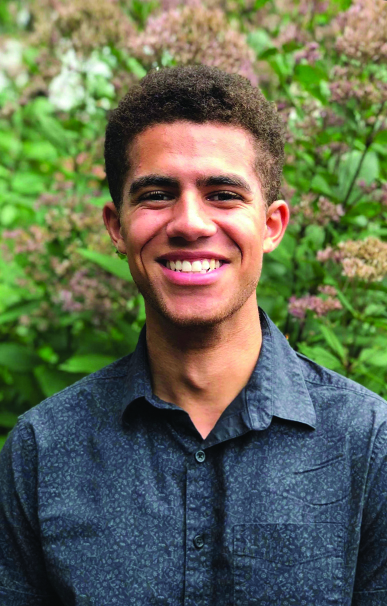
Computer Science
Tracking the Expansion of Corrosive Waters in the Global Ocean in Earth System Model Projections
Certificate(s): Statistics and Machine Learning
I worked to quantify the pace of migration necessary for calcifying marine organisms to remain within habitable regions. I refined the measurement of climate velocity — which is a metric for how quickly environmental boundaries migrate due to climate change — to provide better insight into when and where organisms will face danger, and how quickly they must adapt. I analyzed 30 Earth system model simulations of the years 1950-2100, focusing mainly on carbonite-ion concentration in seawater. With an improved “escape velocity” calculation, I tracked the movement of the critical undersaturation boundary in which calcifying organisms can no longer build their shells or skeletons, and developed novel ways to visualize that information. I found that calcifying organisms globally and regionally must migrate increasingly quickly over the 21st century, particularly from the early- to mid-21st century in a high-emission scenario. In future investigations, my escape-velocity calculation method will be applied to additional climate stressors. During my internship, I learned about climate modeling, oceanography, managing large data sets and how to navigate the nonlinear research process. I hope to continue investigating current issues with data science through my independent work at Princeton.
2020
Climate and Environmental Science
Sarmiento Group, Program in Atmospheric and Oceanic Sciences, Princeton University
George J. Magee Professor of Geoscience and Geological Engineering, Emeritus, Professor of Geosciences, Emeritus; Graeme MacGilchrist, Postdoctoral Research Associate, Atmospheric and Oceanic Sciences; Sarah Schlunegger, Postdoctoral Research Associate, Atmospheric and Oceanic Sciences