



Sara Grossman
2025-2026 Barron Visiting Professor in the Environmental Humanities
Biography
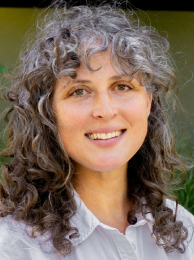
Sara J Grossman is an Associate Professor of Environmental Studies on the Johanna Alderfer Harris and William H. Harris Professorship in Environmental Studies at Bryn Mawr College. At Bryn Mawr, she develops and leads the Environmental Humanities sector of the college’s Environmental Studies major. Over the years, she has developed community partnerships with Philadelphia Community Wireless and Experimental Farm Network, bringing applied and community-based approaches to undergraduate environmental humanities curriculum.
Grossman is a poet and environmental humanities scholar whose research focuses on socio-cultural histories of environmental science and the evolution of community data practices in the United States, as well as environmental histories of disability and multigenerational disability organizing within the United States. Her first book of poems, Let the House of Body Fall, was published in 2018 with New Issues Poetry & Prose. Her first academic monograph, Immeasurable Weather: Meteorological Data and Settler Colonialism from 1820 to Hurricane Sandy, won the 2024 Michelle Kendrick Book Prize from the Society for Literature, Science, and the Arts. In this book, Grossman’s researched how environmental data collection has been central to the larger project of settler colonialism in the United States. From nineteenth-century data-gathering practices of settler farmers and teachers to the automation of weather data during the Dust Bowl and the role of meteorological satellites in data science’s integration into the militarized state, Grossman’s work shows how weather science reproduced the natural world as a measurable, ownable, and exploitable entity. She is currently at work on a new book, Fighting for a Livable Future: Twentieth Century Stories of Disabled Life and Organizing, which explores the kinds of futures disabled communities have fought for across the twentieth century. Her research brings together histories of disabled survival with present-day calls for more diverse and experimental techniques for living in and amid environmental change.
Grossman’s work has been published in The Journal of Women’s History, Isle, Disability Studies Quarterly, Guernica, Verse Daily, and elsewhere. She has received fellowships from the Smithsonian Institution, National Endowment for the Humanities, The MacDowell Colony, Hedgebrook, and elsewhere.
While at Princeton
While at Princeton, Grossman developed courses, workshops, and a public talk broadly centered around the role of mending and repair in environmental history and culture. In Fall of 2025, Grossman developed “Lessons on Mending: A Weather Printing Workshop” for environmental studies minors. While numerical weather recording and prediction is a powerful way to express local weather conditions and global shifts in climate, “Lessons on Mending” experimented with extra-numerical ways of rendering weather,, ways that might prove equally meaningful in and across our relationships with local environments. The workshop utilized a nineteenth-century photographic printing process, known as cyanotype. Inspired by Annalisa Mercuri’s “The World’s Weather Diary,” Grossman and her workshop participants created cyanotype prints to capture the daily weather that surrounded Briger Hall by placing 4×6 inch squares of cyanotype cloth outside the hall at the same time roughly every three days from November to mid-December. At the time of exposure, Grossman and her students placed one ice cube on the cloth. The cube then melted at varying speeds, depending on temperature, and refracted sunlight in differing ways depending on cloud cover. These differences created unique weather prints.
Grossman continued this work in the Spring of 2026 with her course, “An Environmental History of Repair,” where students not only proceeded with the weather printing project from the fall workshop, but also linked such practices to questions of waste and repair. In this course, Grossman and her students explored the pervasiveness of waste in contemporary U.S. life and asked why a waste mindset has informed the treatment of people, places, and ecosystems. This class addressed the use of waste alongside histories of social movements devoted to adaptation, maintenance, and repair, and was rooted in case studies from disability history, pyrophyte plants, and fixit culture, this course surveys what it means to live, and die well, in a culture of mending. Students continued their weekly cyanotypes and practices physical mending by hand stitching the weather prints into a course quilt.
Grossman’s year at Princeton allowed her to complete archival work for sections of her book, Fighting for a Livable Future. Throughout the year, Grossman worked with materials from medical archives that speak to ways that disabled youth both utilized, and were treated with, forms of nature in pediatric hospital settings. Of these materials, Grossman’s research asked: What do we learn when we look toward disability history with an attention to the varied ways that disabled people—and especially youth—have learned to survive in a world that has been openly hostile to them? What might such learning have to offer to our current moment, as we experience both the vulnerability and hostility of earth systems under changing climates?
As a culmination of this research, Grossman offered a public talk, “The Companion Earth: An Environmental History of Pediatric Hospitalization, 1920-1960,” on May 5th, 2026. In this talk, Grossman shared archival research on the ways children engaged and were engaged by nature in long-term pediatric hospitals in the early- to mid-twentieth century. Primary source material from this period, Grossman argued, presents a novel opportunity to re-situate disability history as a form of environmental history and recast the central relation between disabled peoples and their environment. By examining how environments became companions for children living in isolation and often under conditions of medical distress, this talk highlighted disabled youth as central agents in environmental meaning-making.
In addition to this work, Grossman also collaborated on a soon-to-be published forum (January 2027) for the Journal of Environmental History, titled “Disability and Environmental History: An Interdisciplinary Forum.” The forum brings together leading voices in environmental history to explore the new axis and intersections of disability and environment.