



2025 Internship Project Overview
Our project examined biocultural diversity (BCD) in the aquatic wildlife trade, with a focus on less-studied urban systems, to explore how social and ecological dimensions interdependently shape these trade networks.
Biocultural diversity highlights that the diversity of life encompasses not only biological variation but also cultural diversity—worldviews, languages, practices and values—that both shape and are shaped by local environments.
To identify research trends and gaps in this niche field, we conducted a systematic review of empirical studies on urban aquatic wildlife trade. While individual studies often address aspects of BCD, the field remains fragmented and lacks systems-level analysis.
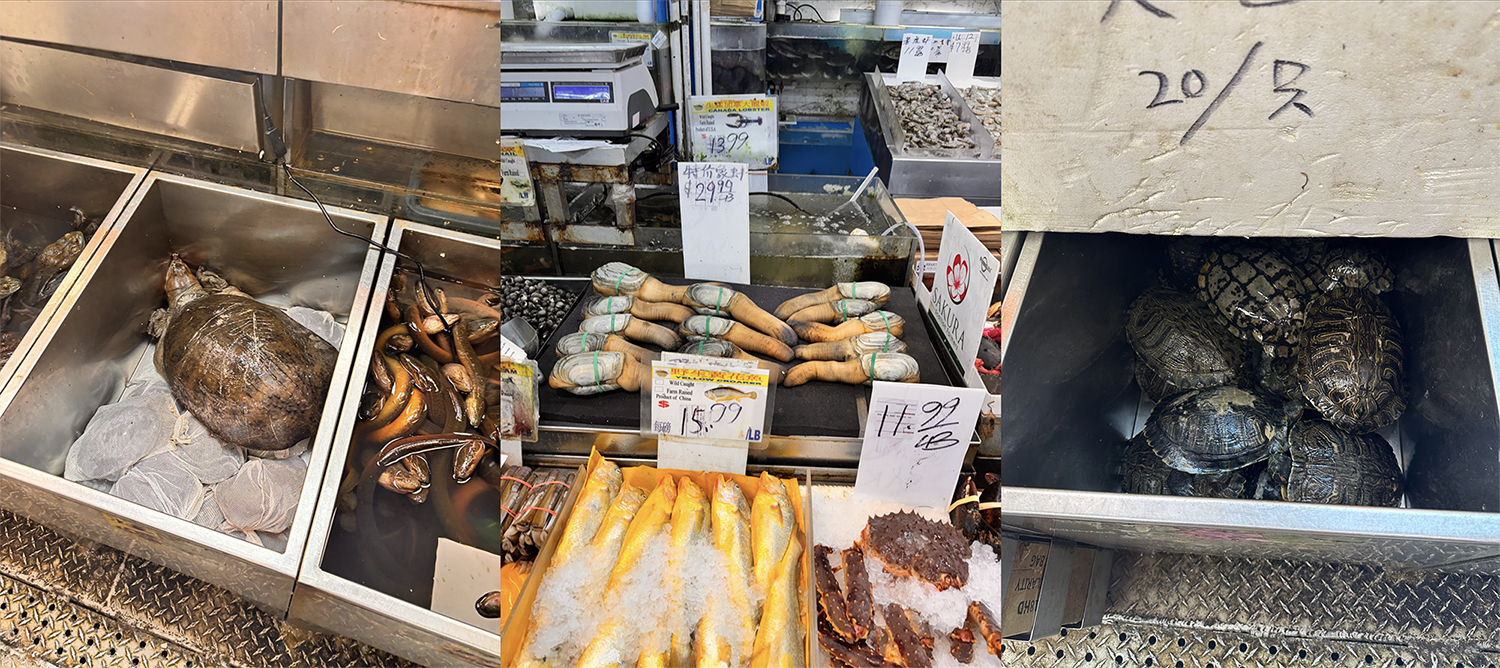
We also conducted quasi-ethnographic fieldwork in New York City’s Chinatowns, observing trade in fish markets and medicinal shops. We developed a questionnaire to collect systematic data on these practices.
This work represents an early step toward understanding urban aquatic wildlife trade and building a more holistic, just and inclusive approach to conservation science.
ORGANIZATION/RESEARCH GROUP
High Meadows Environmental Institute; Fuentes Research Group, Department of Anthropology, Princeton University
LOCATION
Princeton, New Jersey; New York, New York
Interns

Minor(s): Environmental Studies, Journalism

Click to view the end-of-project presentation
Principal Investigator

Mentors
- Christian Rivera, Postdoctoral Research Associate, High Meadows Environmental Institute